











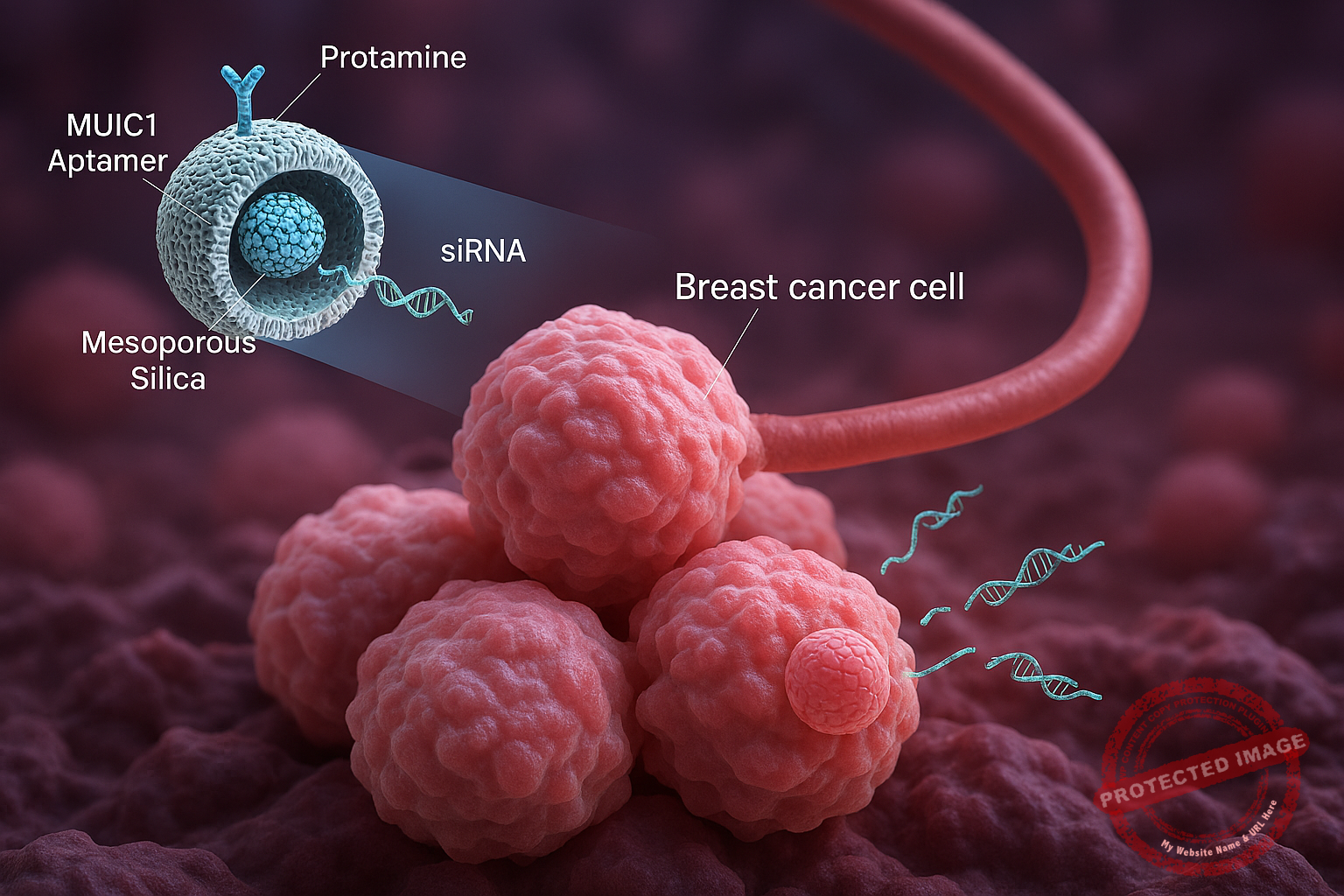
Scientists in Pune have developed a new way to fight breast cancer by “switching off” the genes that help tumors survive and grow. This approach uses specially designed, tiny biodegradable particles to deliver gene-silencing molecules directly into cancer cells, offering a targeted and potentially safer alternative to traditional treatments like chemotherapy.
The research, carried out at the Agharkar Research Institute (ARI), focuses on advanced nanomedicine—an emerging field that uses extremely small materials to treat diseases with high precision. Instead of attacking the whole body, this method aims to zero in on cancer cells while leaving healthy tissues largely unaffected.
At the heart of the study is a smart delivery system made from mesoporous silica nanoparticles. These particles are known for their ability to carry and release large amounts of therapeutic material. The scientists enhanced them by adding a natural protein called protamine and a special targeting molecule known as an aptamer, which can recognize and bind to MUC1—a protein found in high amounts on the surface of breast cancer cells. This allows the nanoparticles to home in on tumors more accurately, improving treatment efficiency and reducing unwanted side effects.
Once the nanoparticles reach the cancer cells, they release small interfering RNA (siRNA), which blocks the activity of specific genes. What makes this study particularly significant is its dual-target approach. The system simultaneously silences two genes, MCL-1 and Survivin, both of which play a major role in helping cancer cells avoid death and resist treatment. By targeting both at once, the therapy delivers a stronger blow to the tumor.
The release mechanism is also carefully designed to respond to the tumor’s internal environment. Cancer cells often have higher levels of a substance called glutathione, and the nanoparticles take advantage of this by releasing their payload only after entering the tumor. This ensures that the treatment works precisely where it is needed.
Laboratory tests using breast cancer cells showed that the treatment successfully reduced the activity of the targeted genes, leading to increased cancer cell death and significant slowing of tumor growth. Further testing in mice with weakened immune systems revealed that the nanoparticles accumulated effectively in tumor tissues without causing noticeable damage to other organs, suggesting low toxicity.
Overall, this breakthrough highlights how combining targeted delivery, controlled release, and multi-gene silencing in a single system can open new doors in cancer treatment. The study offers a hopeful step toward more precise, effective, and safer therapies for breast cancer patients, potentially transforming how the disease is managed in the future.
The work was carried out by a team of researchers including Niladri Haldar, Rajkumar Samanta, Surajit Patra, Devyani Sengar, Sachin Jadhav, and Virendra Gajbhiye from the Nanobioscience Group at ARI in Pune.