










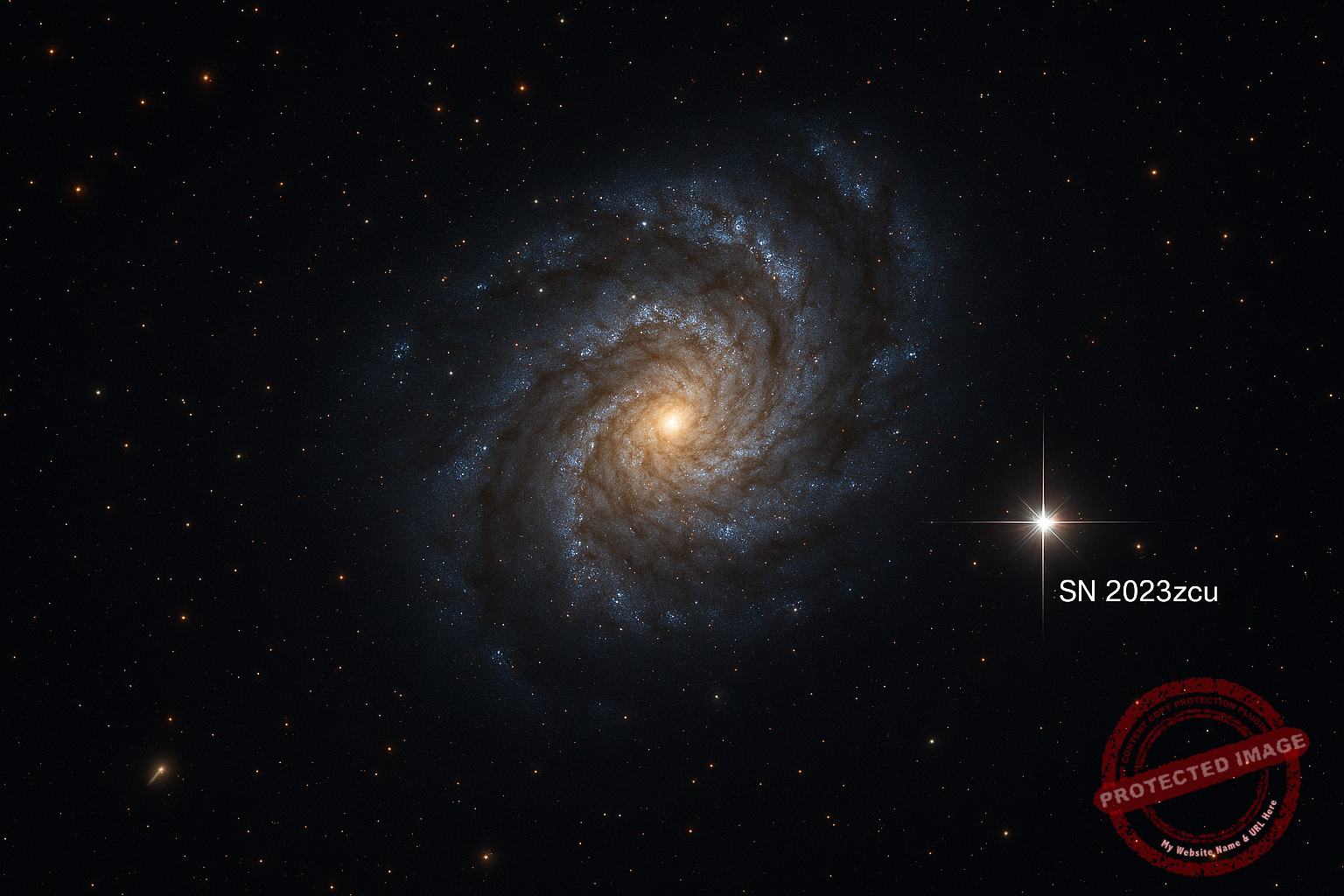
A powerful stellar explosion detected late in 2023 is offering scientists a clearer way to measure distances across the nearby universe. The event, known as SN 2023zcu, was spotted on December 8 at the edge of the spiral galaxy NGC 2139, roughly 90.7 million light-years from Earth, and has since been closely tracked by astronomers around the world.
Supernovae like SN 2023zcu mark the violent deaths of massive stars. When such stars run out of nuclear fuel, they can no longer hold themselves up against gravity. Their cores collapse, triggering a massive explosion that briefly outshines entire galaxies. These dramatic events are not only visually spectacular but also essential for the cosmos, as they forge and spread heavy elements that later form new stars, planets and even life.
SN 2023zcu belongs to a common class called Type IIP supernovae, which occur when a red supergiant star about 8 to 17 times heavier than the Sun reaches the end of its life. In this case, the star’s core collapsed to form a dense object, while its outer layers were blasted into space by a powerful shock wave. The explosion causes the star to brighten rapidly before gradually cooling as the material expands outward.
What makes Type IIP supernovae especially interesting is a stage called the “plateau phase.” During this period, which lasts for several months, the brightness of the explosion remains nearly constant. This happens because hydrogen in the star’s outer layers recombines and releases energy in a steady way. Scientists can clearly identify this stage in observations, along with strong hydrogen signatures in the light spectrum.
Because SN 2023zcu was discovered within a day of its explosion, astronomers were able to study it in exceptional detail from the very beginning. The research, carried out by a team including scientists from the Aryabhatta Research Institute of Observational Sciences (ARIES) in India and international collaborators, has been published in The Astrophysical Journal. Using both ground-based and space telescopes, the team tracked how the supernova evolved over time.
One of the most important outcomes of the study is a precise estimate of its distance. Scientists used a technique known as the Expanding Photospheric Method, which compares how large the exploding star actually is with how bright it appears from Earth. This approach works particularly well for Type IIP supernovae because their thick hydrogen envelopes create a stable and well-defined emitting surface. Based on this method, the researchers estimated the distance to SN 2023zcu to be about 27 megaparsecs, or roughly 90 million light-years, in agreement with the known distance of its host galaxy.
The observations also shed light on the star’s life before it exploded. Early data showed very little interaction between the supernova material and surrounding gas, suggesting the star did not lose much mass in its final stages. As the explosion entered the plateau phase, the spectra revealed not only hydrogen but also elements such as iron, sodium and calcium, indicating that new elements had been formed during the blast. Later, in what is known as the nebular phase, the expanding material became more transparent, allowing scientists to detect faint “forbidden” emission lines from elements like oxygen, magnesium and iron—signatures that appear only in extremely low-density environments.
By analyzing the total energy emitted across all wavelengths, or bolometric luminosity, the team was also able to estimate the properties of the original star. Their results suggest that the progenitor had a mass about 12 times that of the Sun and that the explosion released an energy of around 2 × 10⁵¹ ergs, both typical for red supergiant supernovae.
Researchers say that continuous monitoring of events like SN 2023zcu—from the initial burst of light through the plateau and into the fading nebular stage—is essential for improving our understanding of how massive stars end their lives. At the same time, such studies help refine techniques used to measure cosmic distances, an important step in mapping and understanding the structure of the universe.