










If there were a report card for the newly reconstituted Karnataka cabinet, it would read like a curious mix of “all passed” and “all charged.” A fresh analysis by the Association for Democratic Reforms (ADR) and Karnataka Election Watch has found that every one of the 13 ministers studied has declared criminal cases against themselves, making it a rare moment of complete consensus in politics.
The report examined self-sworn affidavits from the 2023 Assembly elections after the cabinet reshuffle on June 3, 2026. One minister, KJ George from Sarvagnanagar, escaped this statistical spotlight—not due to a clean chit, but because his full affidavit was apparently missing from the Election Commission’s website at the time.
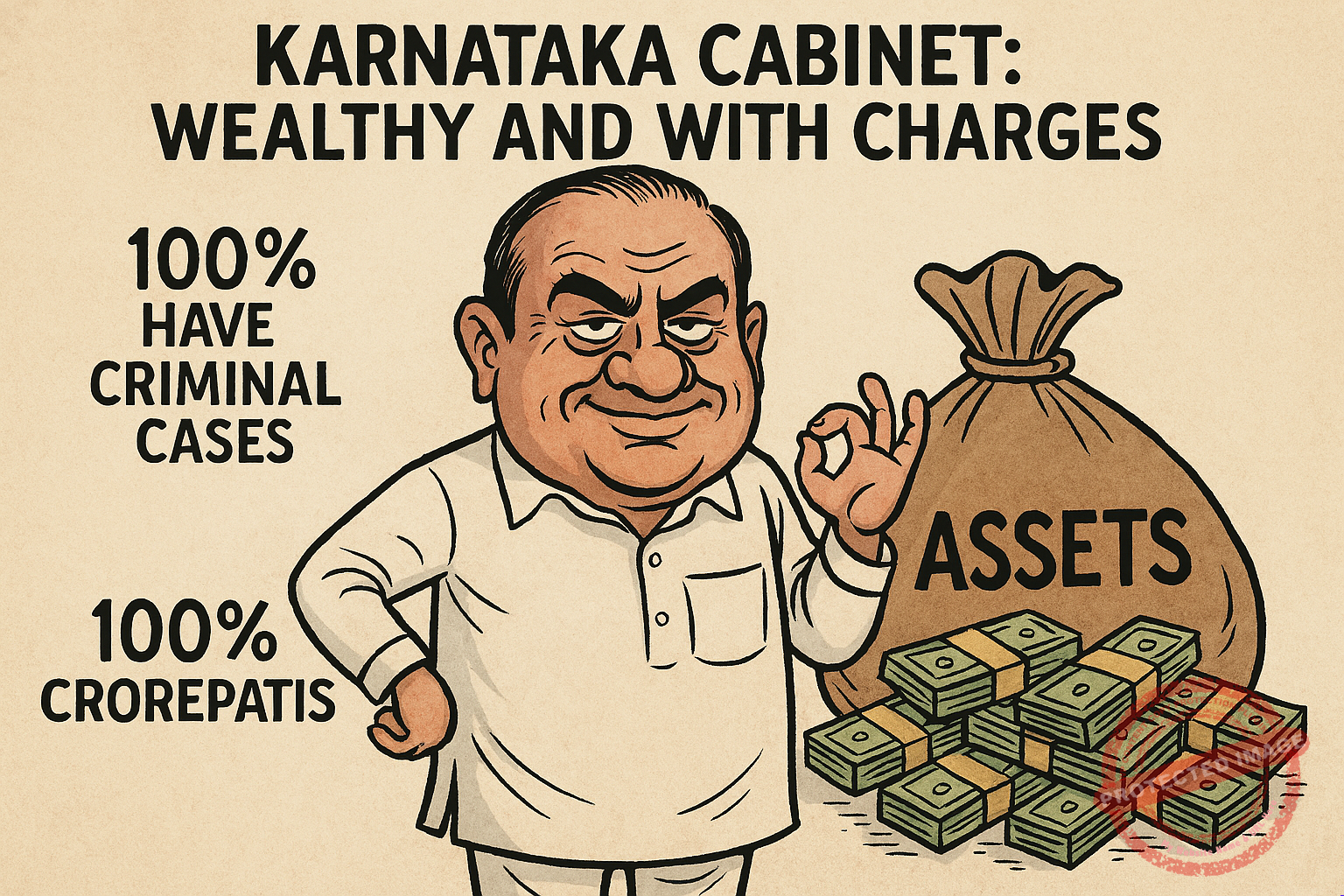
Among those analysed, all 13 ministers—yes, 100%—have criminal cases, with three of them facing serious ones. Clearly, competition in the cabinet does not end at elections.
But if criminal cases are one common thread, wealth is the other. Every minister is a crorepati, with an average asset value of Rs 206.15 crore. Topping the rich list is Deputy Chief Minister DK Shivakumar, whose declared assets stand at a staggering Rs 1,413.80 crore. At the other end, UT Khader Fareed, with Rs 6.97 crore, might technically be the “poorest,” though still far removed from everyday definitions of the word.
Liabilities, too, are a shared burden. All ministers have declared debts, with Shivakumar again leading the chart at Rs 265.06 crore—proving that even immense wealth comes with equally impressive bills.
On the education front, the cabinet leans towards higher qualifications, with 77% of ministers being graduates or above, while the rest report schooling between Class 10 and 12. Age-wise, experience dominates, with the majority between 51 and 75 years, and only a handful in their forties.
And in a final twist that might surprise no one watching closely, the 14-member cabinet has zero women ministers—an absence that speaks louder than any statistic in the report.
All in all, the findings present a cabinet that is united in wealth, experience and, somewhat awkwardly, in criminal disclosures—raising the familiar question of whether transparency alone is enough, or if voters were simply choosing from what was available on the ballot.