










Once every five years, India’s MPs make a solemn promise to the nation—and an even more revealing promise on paper. Hidden inside thick stacks of nomination documents lies a small but powerful truth serum: the self‑sworn affidavit. When the Association for Democratic Reforms (ADR) and National Election Watch lined up these affidavits across a decade, the numbers told a story that didn’t need much embellishment.
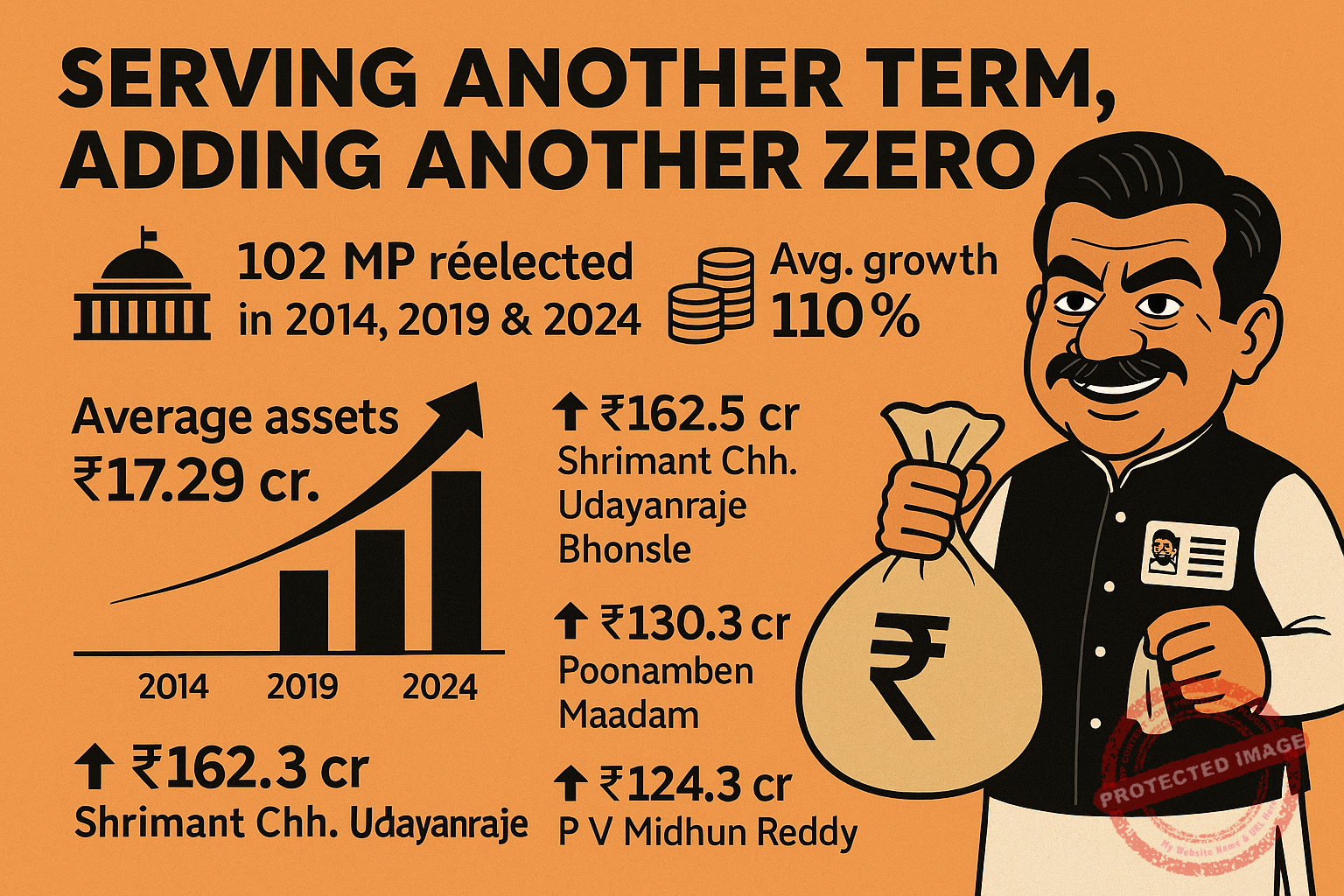
The study looked at 102 Members of Parliament who won re‑election thrice—2014, 2019 and 2024. One MP from Uttar Pradesh was left out only because his 2019 affidavit couldn’t be found, a rare moment when paperwork, not politics, reduced the sample size. Everyone else stayed firmly in the frame.
Back in 2014, these 102 MPs reported average assets of Rs 15.83 crore each. Respectable, some might say. Five years later, in 2019, that average had climbed to Rs 24.21 crore. By 2024, it had reached Rs 33.13 crore. Over ten years, the average increase came to Rs 17.29 crore per MP—an average growth of 110%.
To put it simply, while inflation rose, savings strained and salaries crawled, these affidavits show wealth sprinting confidently ahead.
Some stories within the story stand out. Shrimant Chh. Udayanraje Pratapsinhamaharaj Bhonsle of Satara recorded the largest rise: from Rs 60.60 crore in 2014 to Rs 223.12 crore in 2024—a jump of Rs 162.51 crore.
Poonamben Hematbhai Maadam of Jamnagar saw her declared assets multiply by over eight times, rising from Rs 17.43 crore to Rs 147.70 crore. P V Midhun Reddy of Rajampet added Rs 124.25 crore to his balance sheet over the decade.
These are not allegations or assumptions—just arithmetic based on sworn statements, signed and submitted under oath.
Taken together, the figures quietly underline how electoral continuity often coincides with financial acceleration. The report does not question legality or intent; it simply arranges the numbers in chronological order and lets them speak. And speak they do—clearly, steadily, and with compound interest–level confidence.
In the end, this is less a whodunit and more a ledger tale of Indian democracy. Ballots changed hands, governments changed seats, but one thing kept moving in a single direction: the asset column.
As voters head into every new election, these affidavits remain small windows into big lives—proof that in Indian politics, experience doesn’t just accumulate power, it also compounds wealth.