










Indian democracy, it appears, is not just the world’s largest—it is also one of its most well-endowed. The Association for Democratic Reforms (ADR) and National Election Watch (NEW) have once again opened the affidavits cupboard, and what tumbles out is a fascinating mix of law books, balance sheets, graduation certificates, and a few skeletons that clearly refuse to stay hidden.
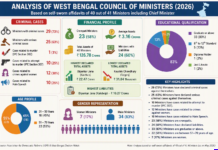
Between 2020 and 2025, 643 out of 652 ministers serving across 27 state assemblies, three Union Territories and the Union Council of Ministers submitted their self-sworn Form 26 affidavits. ADR and NEW analysed these documents, with the important caveat that the current legal status of these cases may have evolved—though the affidavits themselves remain an enduring snapshot of political honesty, frozen in election-time ink.
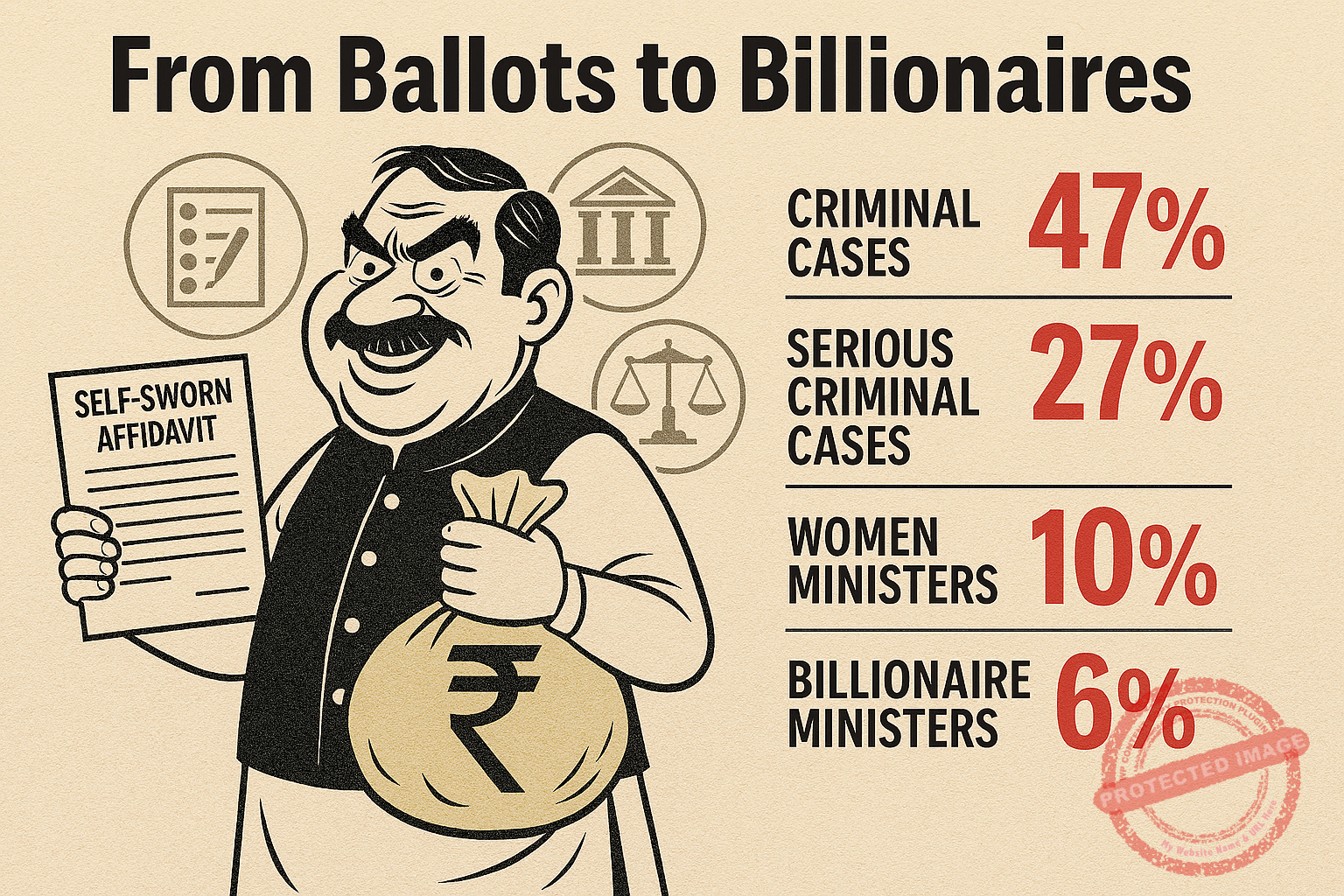
Nearly half the country’s ministers—302 of them, or 47 per cent—have declared criminal cases against themselves. Of these, 174 (27 per cent) are accused in what are delicately termed “serious criminal cases”, a category that includes murder, attempt to murder, kidnapping, and crimes against women. In short, this is not a mild misunderstanding over parking violations.
Party-wise, the picture resembles a competitive sport. Among BJP ministers, 136 out of 336 (40 per cent) have criminal cases, while the Congress outdoes itself with 45 out of 61 ministers (74 per cent). The DMK and TDP appear particularly committed to consistency, with 87 per cent and 96 per cent of their ministers respectively declaring criminal cases. AAP records 69 per cent, Shiv Sena 54 per cent, AITC 33 per cent, and JD(U) emerges as something of a minimalist at 29 per cent. When the lens zooms in on serious criminal cases, the numbers soften only marginally—26 per cent for BJP ministers, 30 per cent for Congress, 45 per cent for DMK and a striking 57 per cent for TDP.
Even the Union Council of Ministers has not stayed aloof from this tradition; 29 out of 72 ministers, or 40 per cent, have criminal cases against them. At the state level, 11 assemblies—including Andhra Pradesh, Tamil Nadu, Bihar, Odisha, Maharashtra, Karnataka, Punjab, Telangana, Himachal Pradesh, Delhi and Puducherry—have the distinction of having more than 60 per cent of ministers with criminal cases. On the brighter side of the ledger, Haryana, Jammu & Kashmir, Nagaland and Uttarakhand can boast that not a single minister has declared any criminal case at all—a rare political cleanse.
If crime is one recurring theme, wealth is another. The average asset owned by a minister across states, UTs and the Union Council stands at a lofty Rs 37.21 crore. Collectively, the 643 ministers own assets worth Rs 23,929 crore, confirming that public service remains one of the most lucrative private callings. Thirty-six ministers, or 6 per cent, qualify as billionaires. Karnataka leads this elite club with eight billionaire ministers, followed by Andhra Pradesh with six and Maharashtra with four. Several other states pitch in with one or two, ensuring geographic diversity in affluence.
Among parties, the BJP has the highest absolute number of billionaires with 14 ministers, though proportionally the Congress does better with 11 billionaires among 61 ministers, and the TDP stands tallest proportionately with more than a quarter of its ministers crossing the billionaire mark. Even the Union Council contributes six billionaires out of 72 ministers, proving that centralisation does not mean austerity.
Gender representation, however, remains modest. Only 63 ministers—10 per cent of the total—are women. West Bengal leads with eight women ministers, followed by Madhya Pradesh and Uttar Pradesh with five each, and Maharashtra with four. Several assemblies, including Goa, Himachal Pradesh, Puducherry and Sikkim, draw a complete blank, suggesting that empowerment is still waiting for a suitable election symbol.
Educational qualifications paint a slightly more encouraging picture. A majority of ministers—71 per cent—are graduates or have higher degrees, while 26 per cent fall between Class 5 and Class 12. There are also 24 diploma holders and, for balance, one minister who has candidly declared himself illiterate, reminding everyone that formal education is optional but confidence is mandatory.
Age-wise, Indian politics remains a middle-aged enterprise. Only 6 per cent of ministers are between 25 and 40 years old, while a comfortable 61 per cent fall in the 41–60 bracket. Seniors dominate the upper end as well, with one-third between 61 and 80 years, and two ministers crossing the age of 80, proving that in politics, retirement is merely a theoretical concept.
Taken together, these affidavits read less like dry disclosures and more like a mirror held up to the system—one that reflects ambition, affluence, legal entanglements and occasional reform, all coexisting quite comfortably. In India’s ministerial ranks, it seems, representation is truly inclusive: of wealth, of age, of education, and, very frequently, of criminal cases.