










India loves to celebrate itself as the world’s largest democracy. It also loves talking about women’s empowerment. Put the two together, and the result—according to a new analysis by the Association for Democratic Reforms (ADR) and National Election Watch (NEW)—is a contradiction so sharp it could cut paper.
The analysis of the self-sworn affidavits of 476 out of 477 sitting women Members of Parliament and Members of Legislative Assemblies across the country including all 75 women MPs in the Lok Sabha and 401 of the 402 sitting women MLAs from 28 states and three Union Territories revealed the uncomfortable numbers.
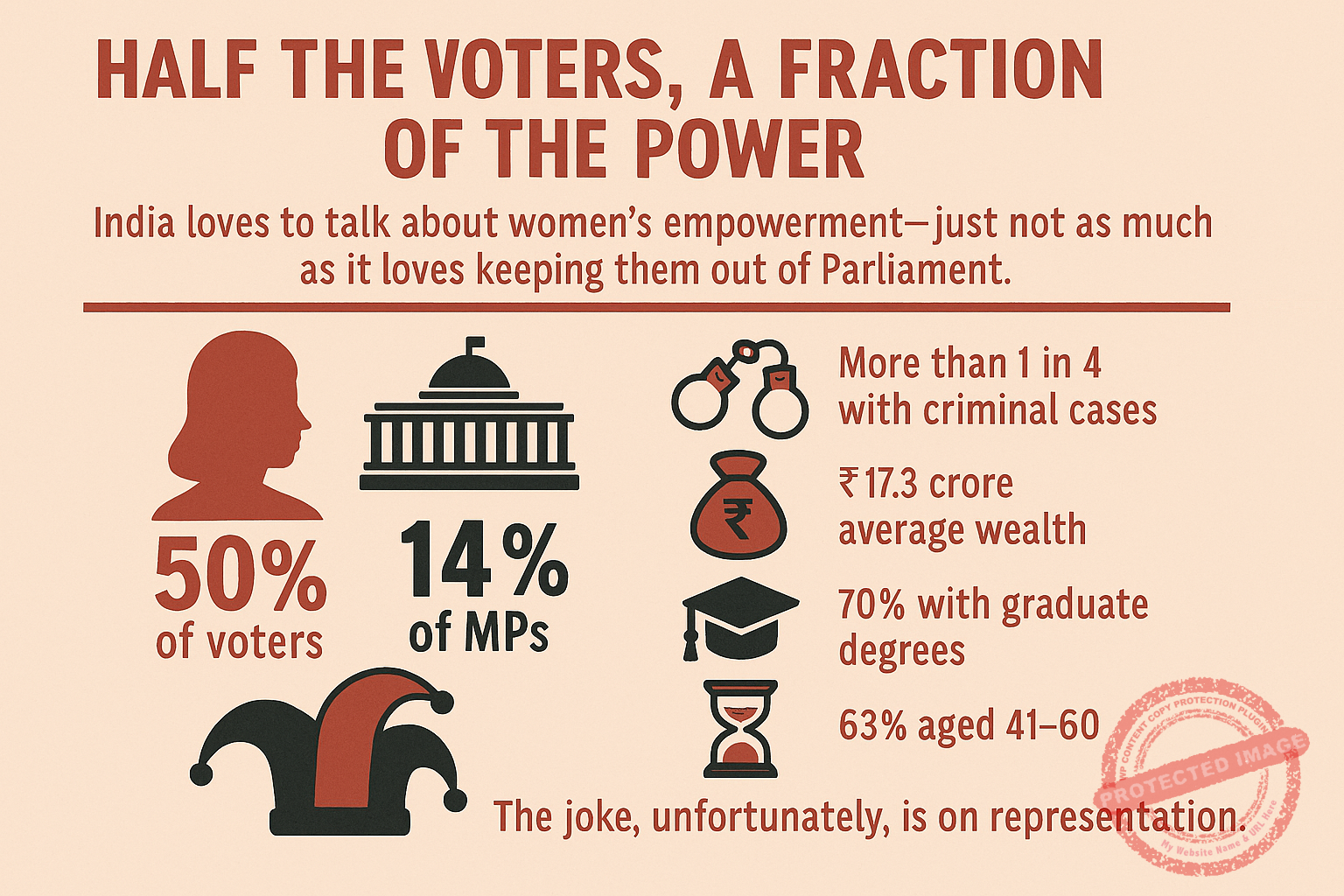
More than one in four sitting women MPs and MLAs—127 in total—have declared criminal cases against themselves. In Parliament, the figure is starker: nearly one-third of women MPs have criminal cases, compared to about one-fourth among women MLAs. And if that’s not dramatic enough, 68 women legislators, or 14 per cent, have admitted to serious criminal cases—those that can invite five years or more in jail. Apparently, glass ceilings crack more easily when money, muscle or legacy lends a hand.
Speaking of money, politics remains an expensive hobby, especially for women. Fourteen of the 476 women MPs and MLAs are billionaires, with Parliament once again leading the way. The average assets of a woman legislator stand at a comfortable Rs 17.30 crore, and together, their collective wealth adds up to a tidy Rs 8,234 crore. Democracy may be priceless, but contesting elections certainly isn’t.
Education-wise, most women legislators come armed with degrees. About 70 per cent are graduates or more, a quarter studied between Classes 5 and 12, a handful hold diplomas, and a small group modestly declared themselves “just literate.” Age-wise, Indian politics continues to favour the middle-aged. Nearly two-thirds of women legislators are between 41 and 60 years old, while the under-40s and over-60s remain in the margins.
All this would be impressive—if women weren’t nearly half the country’s population. India has 662.9 million women voters, yet women make up only 14 per cent of the current Parliament. Globally, India stands at a humbling 151 out of 185 countries in terms of women’s representation. For a nation that prides itself on leadership, this is less global power and more global embarrassment.
There is no shortage of explanations. Money tops the list. As an old IPU survey pointed out, lack of finances is one of the biggest barriers for women entering politics. The numbers from the 2024 General Election confirm it: a woman candidate with assets below Rs 1 crore had just a 1.49 per cent chance of winning. Independent women candidates fared even worse—all 279 of them lost. Freedom, it turns out, is expensive.
Then come the familiar villains: male-dominated party structures, opaque ticket distribution, lack of internal democracy, and the unshakeable belief that women are “less winnable.” Many women who do make it are from political families, often contesting safe seats kindly vacated by male relatives. Merit may matter, but lineage still matters more.
India has given women 50 per cent reservation in urban local bodies and enthusiastically counts women voters every election. But when it comes to real power in State Assemblies and Parliament, the door remains only slightly ajar. Until parties loosen their grip, open their wallets to new faces, and stop treating women’s representation as a charitable gesture, Indian democracy will continue to perform empowerment on stage while practising exclusion backstage.
Half the voters are women. The joke, unfortunately, is on representation.
As per the ADR report, detailts of one MLA from Puttaparthi in Andhra Pradesh could not be analysed—her affidavit, ironically, was missing from the Election Commission’s website. Transparency, it seems, is not always available on request.
The report also mentioned that “The data, drawn from Form 26 affidavits filed during elections between 2021 and 2026, relies entirely on what candidates chose to disclose. What happened to those criminal cases later is anybody’s guess. ADR clearly states it depends on sources beyond its control—India’s favourite disclaimer.”