











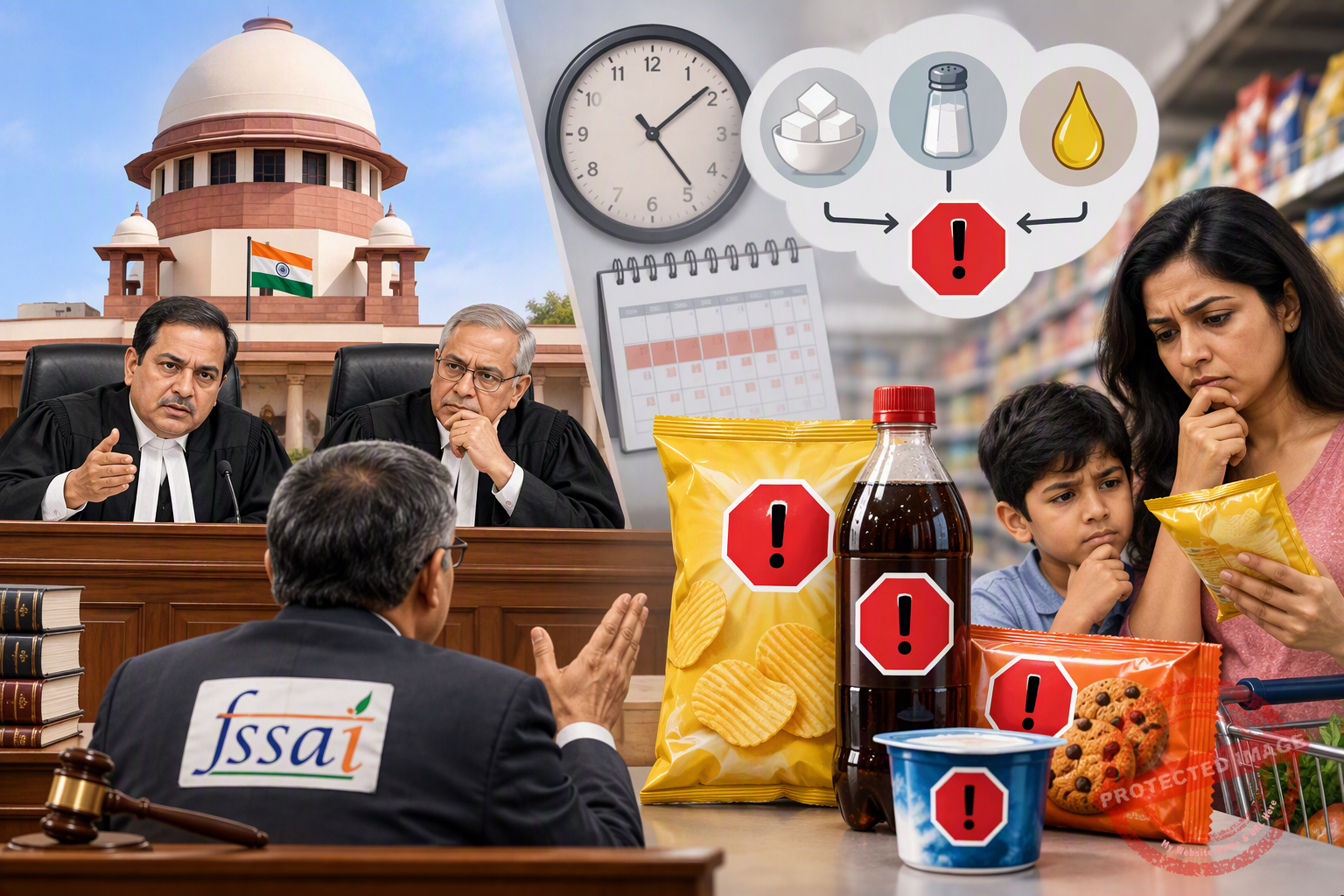
A bench of Justice J.B. Pardiwala and Justice K. Vinod Chandran appreciated the work done by FSSAI so far but made it clear that much more was needed to make the proposed food-labelling system meaningful. The court said the exercise was being undertaken in the interest of the country and its citizens and expected FSSAI to implement its eventual directions in their true spirit.
The bench was particularly unimpressed with FSSAI’s proposal to give food businesses 365 days of voluntary compliance after notification of the new regulations. It questioned why the regulator needed a full year and why fresh consultations were necessary when the regulatory exercise had begun in 2022.
FSSAI responded that the process started in 2022 concerned the Indian Nutrition Rating (INR) or star-rating system, while the present warning-label proposal uses a different yardstick.
Red hexagon to flag unhealthy levels
The regulator has now proposed a prominent red hexagonal warning against a white square background on the front of packaged foods containing high levels of nutrients of concern such as sugar, fat and salt. The idea is to give shoppers an easily visible warning instead of making them search through the nutritional fine print on the back of the packet.
FSSAI’s latest proposal moves away from its earlier two-phase model towards a single-phase system, under which a packaged product exceeding the prescribed threshold for even one nutrient of concern could attract a warning label.
Four months for rules, another year for industry
FSSAI told the court that it would require around four months to draft and finalize the regulations. The draft amendments would be kept open for 60 days for comments, including domestic stakeholder consultations and consultation through the WTO platform.
Once the regulations are notified, FSSAI has proposed another 365 days for voluntary implementation by food business operators. The regulator has said the transition period would, among other things, allow companies to deal with stocks of already printed packaging material.
But the long runway drew the court’s sharpest question: if the purpose is protecting health, why should warning consumers have to wait so long?
PIL seeks mandatory warnings
The proceedings arise from a PIL filed by 3S and Our Health Society, seeking mandatory front-of-pack labeling on packaged foods. The objective of FoPL is to enable consumers to quickly identify products containing high levels of sugar, salt or fat and make more informed dietary choices.
FSSAI had earlier defended phased implementation on the grounds that it would improve consumer acceptability and give the food industry sufficient time to reformulate products. The Supreme Court, however, has been questioning both the phased approach and the time sought before compliance becomes compulsory.
With the order now reserved, the court is expected to settle how quickly the warning-label regime should move from proposal to supermarket shelves.