











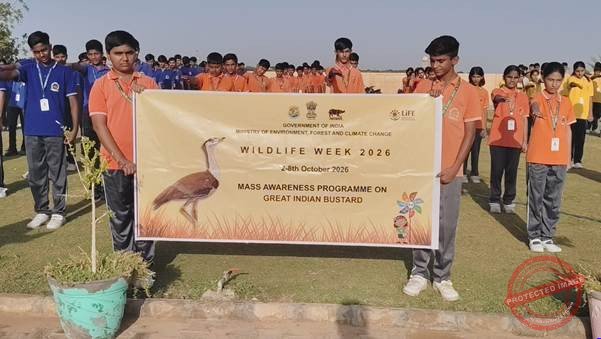
In a major step towards the recovery of the critically endangered Great Indian Bustard (GIB), two captive-bred birds are set to be released into the wild at Desert National Park in Jaisalmer, Rajasthan.
Union Environment, Forest and Climate Change Minister Bhupender Yadav and Rajasthan Chief Minister Bhajan Lal Sharma, who joined virtually, participated in the initiation of the release process during Wildlife Week 2026. The move marks a transition in the conservation program from captive breeding towards rewilding and strengthening the species’ population in its natural habitat.
The dignitaries also reviewed the GIB conservation breeding facilities at Ramdevra and Sam and inaugurated a newly developed rewilding aviary. A brochure documenting the decade-long conservation journey of the species was also released.
Yadav said the Great Indian Bustard has a strong cultural and emotional connection with the Thar Desert. He credited the joint efforts of the Union and Rajasthan governments, Wildlife Institute of India scientists, forest officials and local communities for bringing the program to the rewilding stage.
He said successful GIB conservation could also benefit local communities through ecotourism, besides contributing to grassland conservation and the broader ecology of the Thar.
The new rewilding aviary at Ramdevra measures 160 meters by 64 meters by 14 meters and has been constructed at a sanctioned cost of Rs 9.25 crore. The pillar-less facility is designed to provide captive-bred birds with sufficient flight space to strengthen their muscles, adapt to natural conditions and develop behavior required for survival in the wild.
The GIB conservation program is being implemented jointly by the Union environment ministry, Rajasthan Forest Department and Wildlife Institute of India, with technical collaboration from the International Fund for Houbara Conservation and financial support from National CAMPA.
The breeding facilities at Sam and Ramdevra currently house 97 Great Indian Bustards, including 40 birds originating from wild-laid eggs and 57 bred in captivity. While 86 are being maintained for captive reproduction, 11 have been identified for eventual release into the wild.
The captive-breeding program produced 24 live chicks in 2025 and 29 in 2026. Under the programme’s experimental “jumpstart” initiative, six chicks in Rajasthan and two in Gujarat were successfully hatched after captive-laid eggs were placed in wild nests and accepted by incubating females.
Habitat restoration efforts have also resulted in the establishment of around 200 sq km of fenced grassland enclosures inside Desert National Park, which serve as important breeding habitats for the species.
Officials said the release of captive-bred birds would provide crucial scientific data for developing and refining protocols for future reintroductions. The initial release is being conducted under controlled conditions with limited human presence to minimize disturbance, with lessons from the exercise expected to guide subsequent releases.