











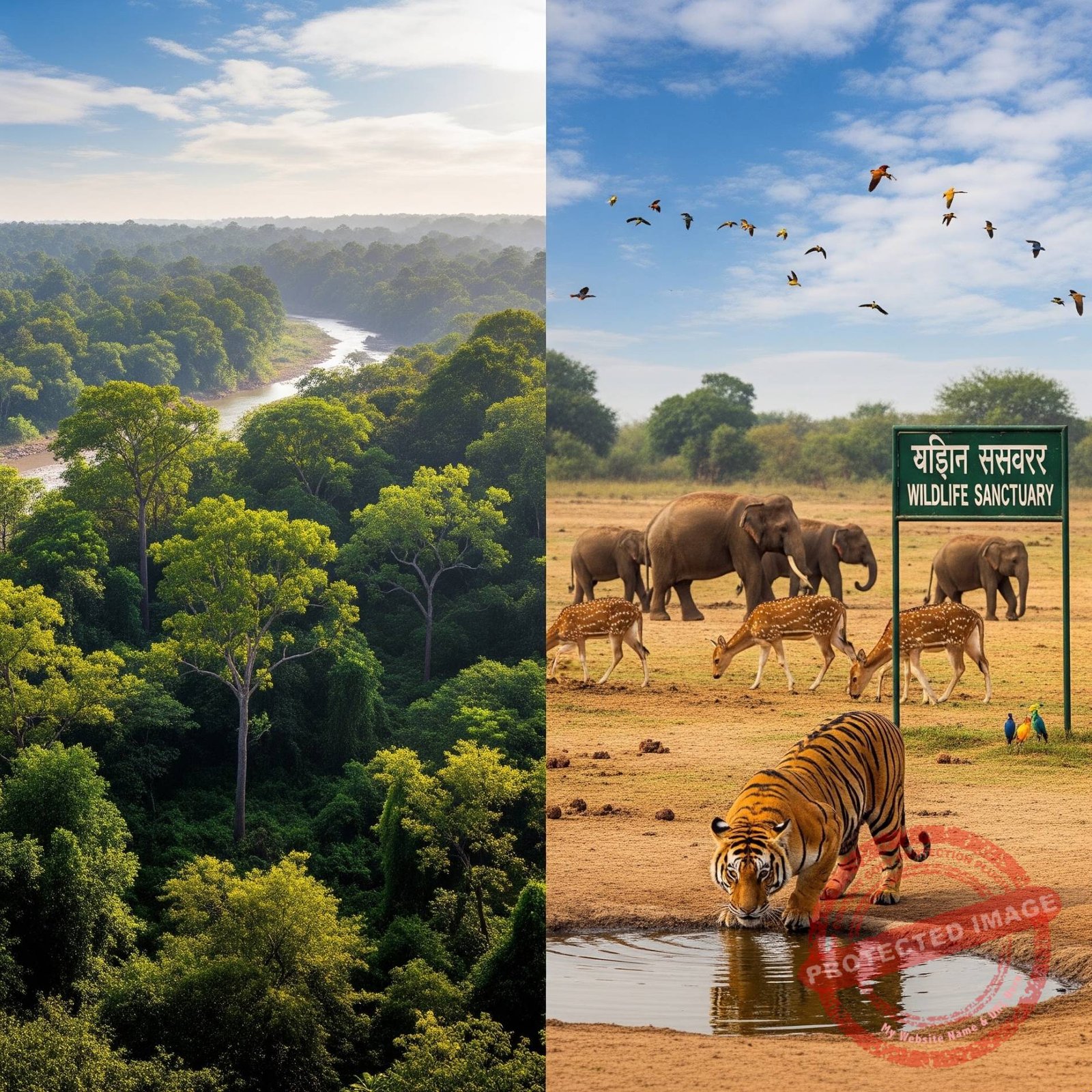
India’s forest and tree cover has continued to grow, with the latest assessment showing an increase of 1,445.81 square kilometres over the past two years. According to the India State of Forest Report (ISFR) 2023, the country’s forest and tree cover now stands at 8,27,356.95 square kilometres, accounting for 25.17 per cent of its total geographical area.
The government has also strengthened wildlife conservation efforts by expanding the network of protected areas across the country. The number of National Parks, Wildlife Sanctuaries, Conservation Reserves and Community Reserves has risen to 1,134. In addition, India currently has 58 Tiger Reserves and 33 Elephant Reserves, reflecting a continued focus on the protection of key wildlife habitats.
To maintain ecological connectivity between critical habitats, authorities have identified 32 tiger corridors and 150 elephant corridors across the country. These corridors are aimed at facilitating the safe movement of wildlife and reducing habitat fragmentation.
The Ministry of Environment, Forest and Climate Change said that diversion of forest land for non-forestry purposes, including infrastructure projects, is regulated under the Van (Sanrakshan Evam Samvardhan) Adhiniyam, 1980. Proposals involving forest land are examined on a case-by-case basis, with due consideration given to forestry, wildlife and environmental concerns. Efforts are made to minimise the use of forest land and reduce fragmentation while evaluating such proposals.
The government has increasingly involved forest-dependent communities in conservation and sustainable forest management. Local participation is being encouraged through Joint Forest Management Committees and Eco-Development Committees established by state governments, particularly around protected areas. These groups contribute to preventing illegal tree felling, controlling forest fires, undertaking afforestation activities and restoring degraded forest areas.
The Scheduled Tribes and Other Traditional Forest Dwellers (Recognition of Forest Rights) Act, 2006 has also strengthened community participation by recognising forest rights and empowering Gram Sabhas to protect, regenerate, conserve and manage community forest resources.
To further enhance forest and tree cover, the Centre is providing technical and financial assistance to states and Union territories through initiatives such as the Green India Mission, Compensatory Afforestation Fund Management and Planning Authority (CAMPA), Nagar Van Yojana and the Mangrove Initiative for Shoreline Habitats and Tangible Incomes (MISHTI).
Forest fire management remains another key area of focus. The National Action Plan on Forest Fires, 2018 provides a framework for prevention, detection and control of forest fires through capacity building, technological interventions and community participation. Financial support is also being extended to states and Union territories under the Forest Fire Prevention and Management Scheme.
The government said that environmental and ecological impacts of mining activities proposed in forest areas are assessed through statutory appraisal processes under various laws, including the Van (Sanrakshan Evam Samvardhan) Adhiniyam, the Environment (Protection) Act, 1986 and the Wild Life (Protection) Act, 1972. Mining proposals are evaluated individually, taking into account local ecological conditions, potential impacts on wildlife and habitats, and the mitigation measures planned by project proponents.
The information was provided by Minister of State for Environment, Forest and Climate Change Kirti Vardhan Singh in a written reply in the Lok Sabha.