India’s railway journey, which began with the first passenger train running from Bombay to Thane on April 16, 1853, has evolved into one of the world’s largest and most modern transport networks. What started as a single steam‑powered service carrying around 400 passengers has, over 173 years, transformed into a nationwide system that today operates nearly 25,000 trains daily and serves as the backbone of the country’s mobility and logistics.
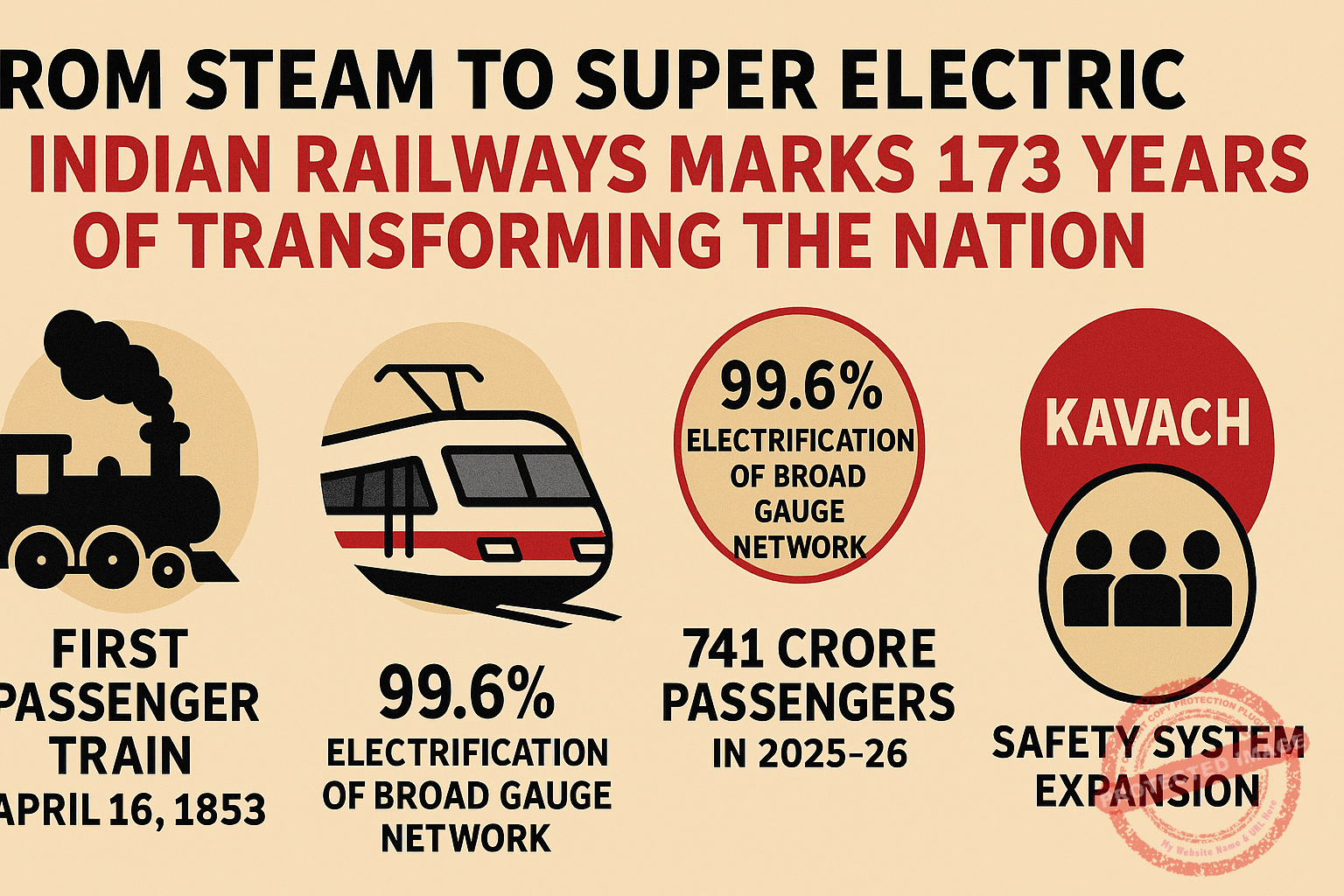
The inaugural train, operated by the Great Indian Peninsula Railway and hauled by a steam locomotive named Falkland, travelled about 34 kilometres amid public celebrations and a 21‑gun salute. That historic journey marked the foundation of Indian Railways and triggered rapid expansion across the subcontinent. By 1880, the railway network had already grown to about 14,500 kilometres, spreading across regions and linking cities, towns and rural areas. The use of different gauges, including broad, metre and narrow gauge, helped extend rail connectivity to challenging terrain and less developed areas, while engineering milestones such as the Darjeeling Himalayan Railway demonstrated innovative solutions for hill transport.
Through the late nineteenth and early twentieth centuries, steam locomotives enabled long‑distance passenger travel and large‑scale freight movement, laying strong operational and engineering foundations. Indigenous manufacturing also took root, with the first steam locomotive built in India produced at the Ajmer workshop in 1895. The transition to electric traction began in 1925 with the first electric train between Bombay Victoria Terminus and Kurla Harbour, signalling gradual modernization.
After Independence in 1947, Indian Railways was consolidated from 42 separate railway systems and reorganised into zones to improve efficiency. Over the following decades, steam engines were phased out, and diesel and electric locomotives became dominant, strengthening the network’s capacity to handle growing traffic. By the end of the twentieth century, railways had established a robust base for a new phase focused on safety, speed and passenger comfort.
In recent years, modernization has accelerated sharply. Indian Railways today has electrified 99.6 per cent of its broad gauge network, covering 69,873 route kilometres as of March 2026, compared with just about 20 per cent electrification before 2014. This shift has reduced diesel consumption significantly, saved an estimated Rs 6,000 crore, cut crude oil imports and made operations cleaner and around 70 per cent more economical. India’s electrification level now exceeds that of several major rail networks globally.
Infrastructure upgrades have kept pace with this transformation. Over 54,600 kilometres of track have been renewed since 2014, and more than 80 per cent of the network can now support speeds of 110 kmph or higher. Safety has also been strengthened with the indigenous Kavach automatic train protection system commissioned over 3,100 route kilometres, with work underway on an additional 24,400 kilometres.
The railways’ scale is reflected in its operations. In 2025–26, Indian Railways carried around 741 crore passengers and moved a record 1,670 million tonnes of freight, with revenues reaching about Rs 80,000 crore. Passenger experience has been upgraded through services such as the Vande Bharat Express, India’s first indigenously designed semi‑high‑speed train, which has carried over 9.1 crore passengers since its launch, including nearly 4 crore in 2025–26 alone. The introduction of the Vande Bharat Sleeper service in early 2026 has added another milestone.
From the steam whistle that echoed across Bombay in 1853 to today’s nearly fully electrified, technology‑driven system, Indian Railways continues to evolve, linking the country at an unprecedented scale while preparing for a faster, safer and more sustainable future.