










A team of Indian scientists has pieced together nearly 4,000 years of climate and environmental history of Majuli Island in Assam, offering fresh insights into how the world’s largest inhabited river island has evolved—and why it remains so vulnerable today.
The study, led by researchers from the Birbal Sahni Institute of Palaeosciences in Lucknow, traces long-term shifts in climate, vegetation and river behaviour, painting a vivid picture of how nature and human influence have shaped the island over centuries. Known for its cultural richness and as a centre of Neo-Vaishnavite tradition, Majuli has also been battling a quieter crisis—relentless flooding and erosion driven by the powerful Brahmaputra River system.
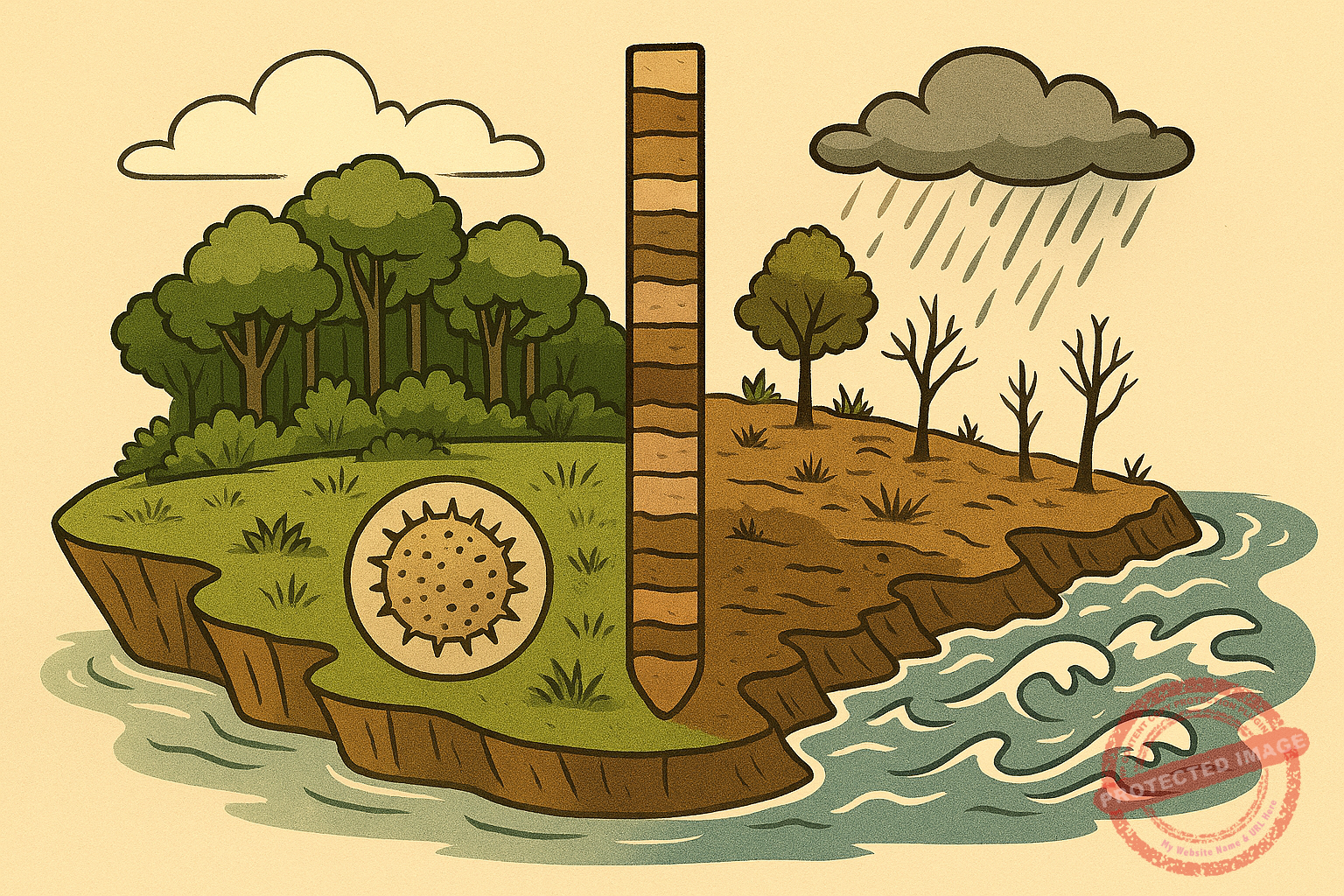
Despite its significance, there had been no detailed reconstruction of Majuli’s environmental past. To fill this gap, scientists extracted a 150-centimetre sediment core from a wetland on the island. By analysing fossil pollen preserved in sediment layers along with grain-size data, they decoded changes in vegetation, rainfall patterns and river dynamics over thousands of years.
Pollen, often invisible to the eye, turned out to be a key to the past. Preserved in sediments over millennia, it can reveal what kinds of plants once thrived, how dense forests were, and what climatic conditions prevailed. Using this evidence alongside modern comparison methods, researchers reconstructed temperature and rainfall patterns dating back to around 4,000 years ago.
Their findings show that Majuli once experienced a warm and humid phase marked by dense forest cover, suggesting that the island’s ecosystem was resilient even during a known global dry event around 4,200 years ago. Over time, however, the region saw fluctuating monsoon strength and shifting flood patterns. A relatively wetter phase between about 1,100 and 500 years ago aligned with the Medieval Climatic Anomaly, a period of climatic variation observed across parts of the world.
But the most recent chapter tells a more worrying story. Over the past 500 years, the study points to declining temperature and rainfall, consistent with the period known as the Little Ice Age. At the same time, human activity began to leave a stronger imprint, with forests thinning and vegetation becoming more scattered.
Equally important are the clues hidden in sediment grain sizes, which indicate how river behaviour has changed. The data suggest a shift from calmer, low-energy conditions to more turbulent flows, pointing to growing hydrological instability. This helps explain why Majuli has become increasingly prone to floods and erosion, with large parts of the island already lost over time.
The study highlights a clear link between local environmental changes and broader global climatic events, underscoring how sensitive the Brahmaputra river basin is to shifts in climate. It also identifies periods when the ecosystem showed resilience, as well as phases of vulnerability.
Researchers say these insights are not just about the past—they are crucial for the future. Understanding how climate, vegetation and river systems have interacted over centuries can help improve flood management, guide conservation efforts and shape sustainable land-use planning on the island.
As Majuli continues to face the twin threats of environmental degradation and climate change, this long-term perspective could prove vital in designing strategies to protect both its fragile ecology and the communities that call it home.
The study, led by researchers from the Birbal Sahni Institute of Palaeosciences in Lucknow, traces long-term shifts in climate, vegetation and river behaviour, painting a vivid picture of how nature and human influence have shaped the island over centuries. Known for its cultural richness and as a centre of Neo-Vaishnavite tradition, Majuli has also been battling a quieter crisis—relentless flooding and erosion driven by the powerful Brahmaputra River system.
Despite its significance, there had been no detailed reconstruction of Majuli’s environmental past. To fill this gap, scientists extracted a 150-centimetre sediment core from a wetland on the island. By analysing fossil pollen preserved in sediment layers along with grain-size data, they decoded changes in vegetation, rainfall patterns and river dynamics over thousands of years.
Pollen, often invisible to the eye, turned out to be a key to the past. Preserved in sediments over millennia, it can reveal what kinds of plants once thrived, how dense forests were, and what climatic conditions prevailed. Using this evidence alongside modern comparison methods, researchers reconstructed temperature and rainfall patterns dating back to around 4,000 years ago.
Their findings show that Majuli once experienced a warm and humid phase marked by dense forest cover, suggesting that the island’s ecosystem was resilient even during a known global dry event around 4,200 years ago. Over time, however, the region saw fluctuating monsoon strength and shifting flood patterns. A relatively wetter phase between about 1,100 and 500 years ago aligned with the Medieval Climatic Anomaly, a period of climatic variation observed across parts of the world.
But the most recent chapter tells a more worrying story. Over the past 500 years, the study points to declining temperature and rainfall, consistent with the period known as the Little Ice Age. At the same time, human activity began to leave a stronger imprint, with forests thinning and vegetation becoming more scattered.
Equally important are the clues hidden in sediment grain sizes, which indicate how river behaviour has changed. The data suggest a shift from calmer, low-energy conditions to more turbulent flows, pointing to growing hydrological instability. This helps explain why Majuli has become increasingly prone to floods and erosion, with large parts of the island already lost over time.
The study highlights a clear link between local environmental changes and broader global climatic events, underscoring how sensitive the Brahmaputra river basin is to shifts in climate. It also identifies periods when the ecosystem showed resilience, as well as phases of vulnerability.
Researchers say these insights are not just about the past—they are crucial for the future. Understanding how climate, vegetation and river systems have interacted over centuries can help improve flood management, guide conservation efforts and shape sustainable land-use planning on the island.
As Majuli continues to face the twin threats of environmental degradation and climate change, this long-term perspective could prove vital in designing strategies to protect both its fragile ecology and the communities that call it home.