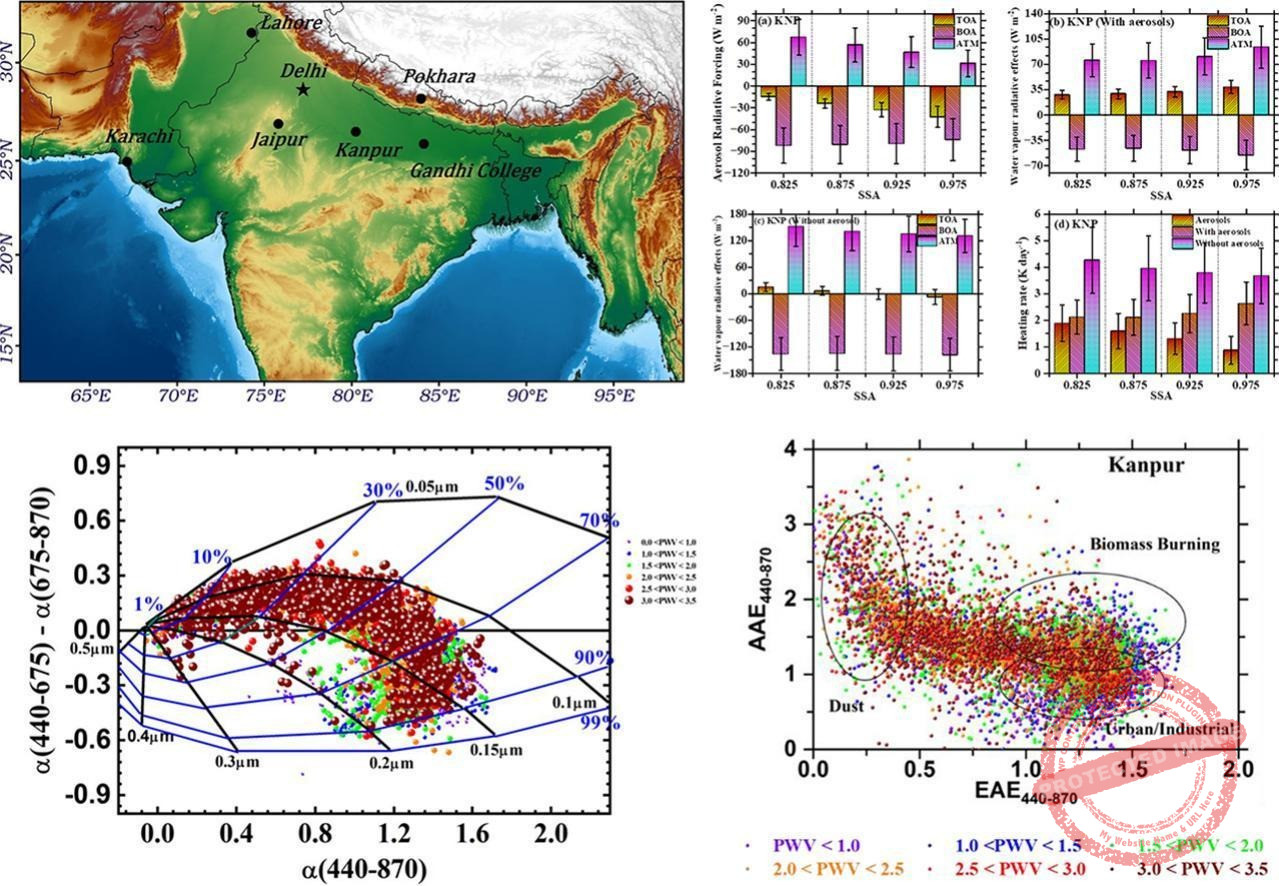
A new scientific study has shed fresh light on how water vapour and aerosols jointly influence climate change, revealing that water vapour contributes significantly more to atmospheric heating than aerosols—especially over the climate‑sensitive Indo‑Gangetic Plain (IGP).
Researchers say the findings could reshape how climate models are developed, as the interaction between aerosols and water vapour plays a far greater role in regional weather patterns and monsoon behaviour than previously understood.
Why This Matters
Aerosols and water vapour are key regulators of the Earth’s radiation balance. They scatter or absorb incoming sunlight and outgoing heat, shaping global temperatures, weather systems, and overall climate stability. But the IGP—one of the world’s most polluted regions—presents unique challenges due to its extremely high variability in aerosol levels and moisture content.
Until now, their combined radiative effects have been difficult to quantify.
The Study
The research was conducted by scientists from the Aryabhatta Research Institute of Observational Sciences (ARIES), Nainital, and the Indian Institute of Astrophysics (IIA), Bengaluru—both under the Department of Science and Technology (DST)—in collaboration with universities in Greece and Japan.
Led by Dr. Umesh Chandra Dumka (ARIES) and Dr. Shantikumar S. Ningombam (IIA), the team analysed data from six AERONET sites across the IGP, using advanced radiative transfer simulations based on the SBDART atmospheric model.
Water Vapour Dominates Atmospheric Heating
The researchers discovered that water vapour has a far stronger atmospheric heating effect than aerosols, especially under clean‑air conditions. Their paper, published in the Atmospheric Research journal, states that:
Water vapour radiative effects (WVRE) intensify significantly when aerosols are minimal, meaning clean atmospheres amplify the warming impact of water vapour.
When aerosols are present, the water vapour effect becomes more pronounced at the top of the atmosphere, pointing to a complex interplay between particles and moisture.
Aerosol–water vapour interactions strongly modulate the regional radiation budget, influencing everything from surface temperatures to the strength of the Indian summer monsoon.
Aerosols still matter — but not as much as Water Vapour
While aerosols are known to scatter sunlight (cooling effect) or absorb heat (warming effect), the study shows that their influence is still weaker than that of water vapour.
In simple terms, water vapour is the bigger heater — aerosols are the modifiers.
This relationship becomes critical for climate modelling over the IGP, where intense pollution and high humidity coexist.
Implications for Climate Projections
The findings highlight the need for more accurate incorporation of aerosol–moisture interactions in climate models, improved forecasting of monsoon variability besides better understanding of regional warming patterns in Northern India
With the IGP being both densely populated and pollution‑heavy, even small miscalculations in radiative effects can distort climate predictions.
A step toward Clearer Climate Understanding
The study underlines that water vapour—a natural component of the atmosphere—plays a far more substantial role in heating than previously quantified, and that ignoring its interaction with aerosols can lead to misleading projections.
As climate models evolve, the researchers stress that only by studying both elements together can India achieve reliable long‑term climate assessments.