









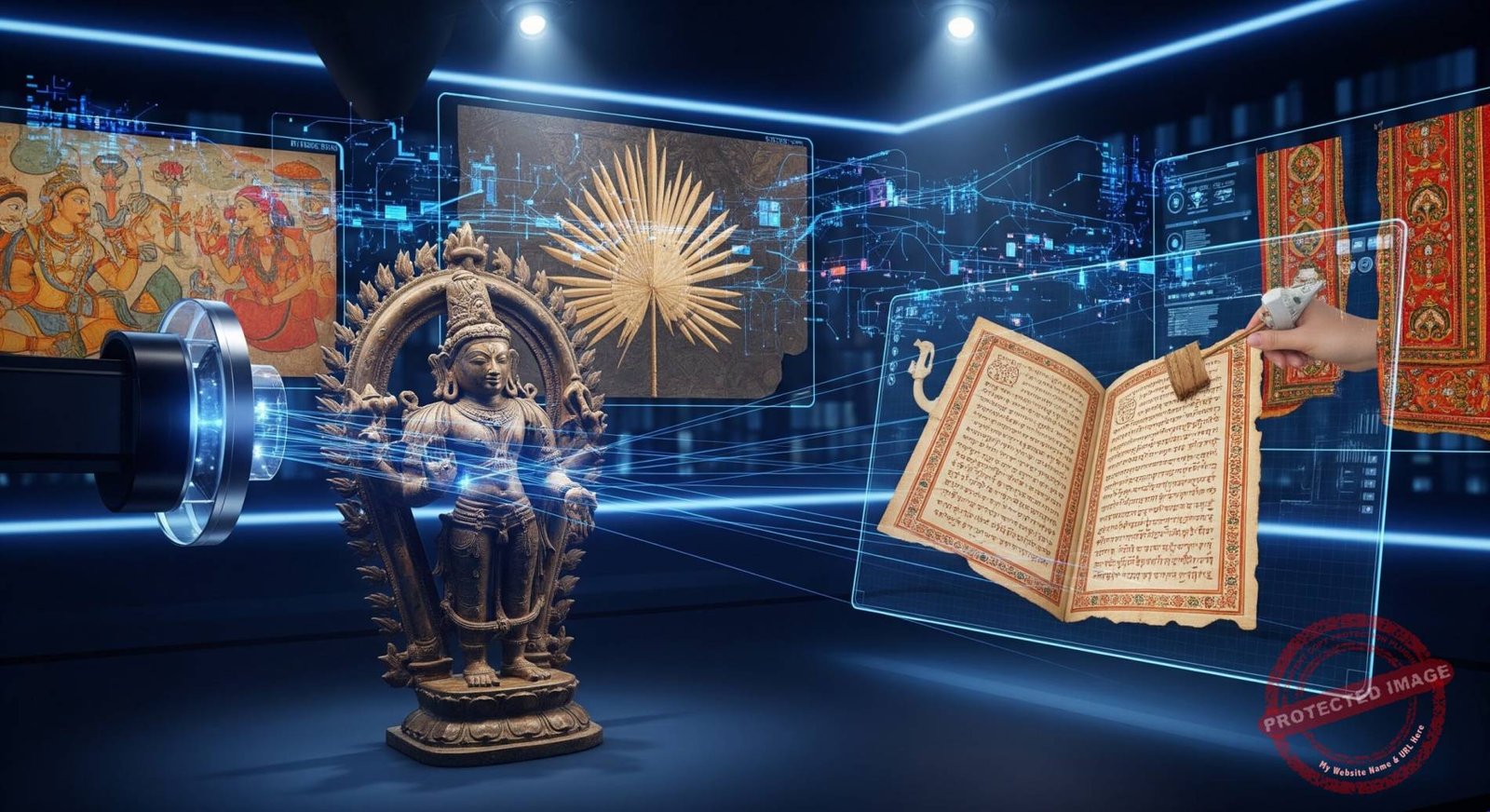
India’s cultural treasures, from ancient manuscripts and museum collections to archaeological artefacts and scientific archives, are increasingly being preserved through digital technology. The Ministry of Culture has undertaken a series of initiatives to digitally safeguard the country’s rich heritage while making it more accessible to researchers, students and the general public.
A key component of this effort is JATAN, a software platform developed by C-DAC, Pune, for digitisation and collection management in museums. Through the Museums of India portal, a national digital repository has been created, bringing together digitised collections from eight national-level museums, two ASI site museums and the Dr Babasaheb Ambedkar Museum in Pune. Visitors can access these collections online, reducing barriers to cultural knowledge.
The Ministry’s Gyan Bharatam Mission is another major initiative aimed at preserving India’s manuscript heritage and reviving traditional knowledge systems. More than 3.5 lakh digitised manuscripts are currently available to the public through the Gyan Bharatam portal, providing unprecedented access to rare and historical texts.
The National Archives of India (NAI) has also intensified digitisation of archival records. These documents are regularly uploaded to its dedicated portal, Abhilekh Patal, allowing scholars and researchers to access valuable documentary heritage online.
In the field of science and technology heritage, the Birla Industrial and Technological Museum (BITM), Kolkata, under the National Council of Science Museums (NCSM), launched the National Science and Technology Digital Archive in December 2024. The platform houses papers, letters and manuscripts of eminent Indian scientists, creating a significant repository of scientific history.
The Indira Gandhi National Centre for the Arts (IGNCA) has developed extensive digital archives covering manuscripts, photographs, rare books, audio-visual recordings, cultural documentation, art objects and other archival collections. These repositories aim to preserve and disseminate India’s diverse cultural legacy.
Technology is also being used to transform museum experiences. NCSM, which oversees 26 science museums and centres across the country, is developing interactive exhibits using artificial intelligence (AI), augmented reality (AR), virtual reality (VR), computer vision and sensor-based technologies. These innovations include motion tracking, eye-tracking, smart content adaptation and touchless interaction systems designed to make learning more engaging and accessible.
The Indian Museum, Kolkata, has partnered with IIT Kharagpur to explore AI-based restoration of archaeological artefacts for digital preservation. The museum has also collaborated with Google Arts & Culture to create virtual exhibitions and has introduced AI-based interactive tools and AR-driven visitor experiences.
Educational outreach has also been strengthened through the Centre for Cultural Resources and Training (CCRT). The organisation regularly conducts training programmes and educational visits to museums, heritage sites and cultural institutions, helping students and teachers engage directly with India’s cultural heritage.
The Archaeological Survey of India (ASI) has expanded digital documentation of monuments and antiquities through the National Mission on Monuments and Antiquities (NMMA). Recently, 723 artefacts from the ASI Museum in Goa and 8,450 artefacts from the ASI Museum at Nagarjunakonda were digitally documented and uploaded onto the JATAN platform.
To improve public access, the Ministry has promoted digitisation of manuscripts, photographs and archival collections, online access to publications, digital documentation of both tangible and intangible heritage and the use of multimedia and interactive technologies during exhibitions and outreach programmes. These efforts have significantly expanded access to cultural resources.
NCSM is also modernising several science centres across the country under the Scheme for Promotion of Culture of Science (SPoCS). Upgradation work is underway at science centres in Ranchi, Tripura, Nagaland, Meghalaya, Mizoram and Manipur, while periodic modernisation plans continue across all NCSM institutions, including the Palampur Science Centre in Himachal Pradesh.
Meanwhile, ASI has introduced mobile applications for its archaeological museums at Hampi in Karnataka and Nalanda in Bihar, enabling visitors to take virtual tours and access information on exhibits digitally.
The IGNCA has also continued documentation, research, publication and digital preservation efforts related to Mithila art, traditions and manuscripts, ensuring that regional cultural traditions remain accessible to future generations.
The information was shared by Union Culture and Tourism Minister Gajendra Singh Shekhawat in a written reply in the Lok Sabha, highlighting the government’s growing emphasis on technology-driven preservation and promotion of India’s cultural heritage.