










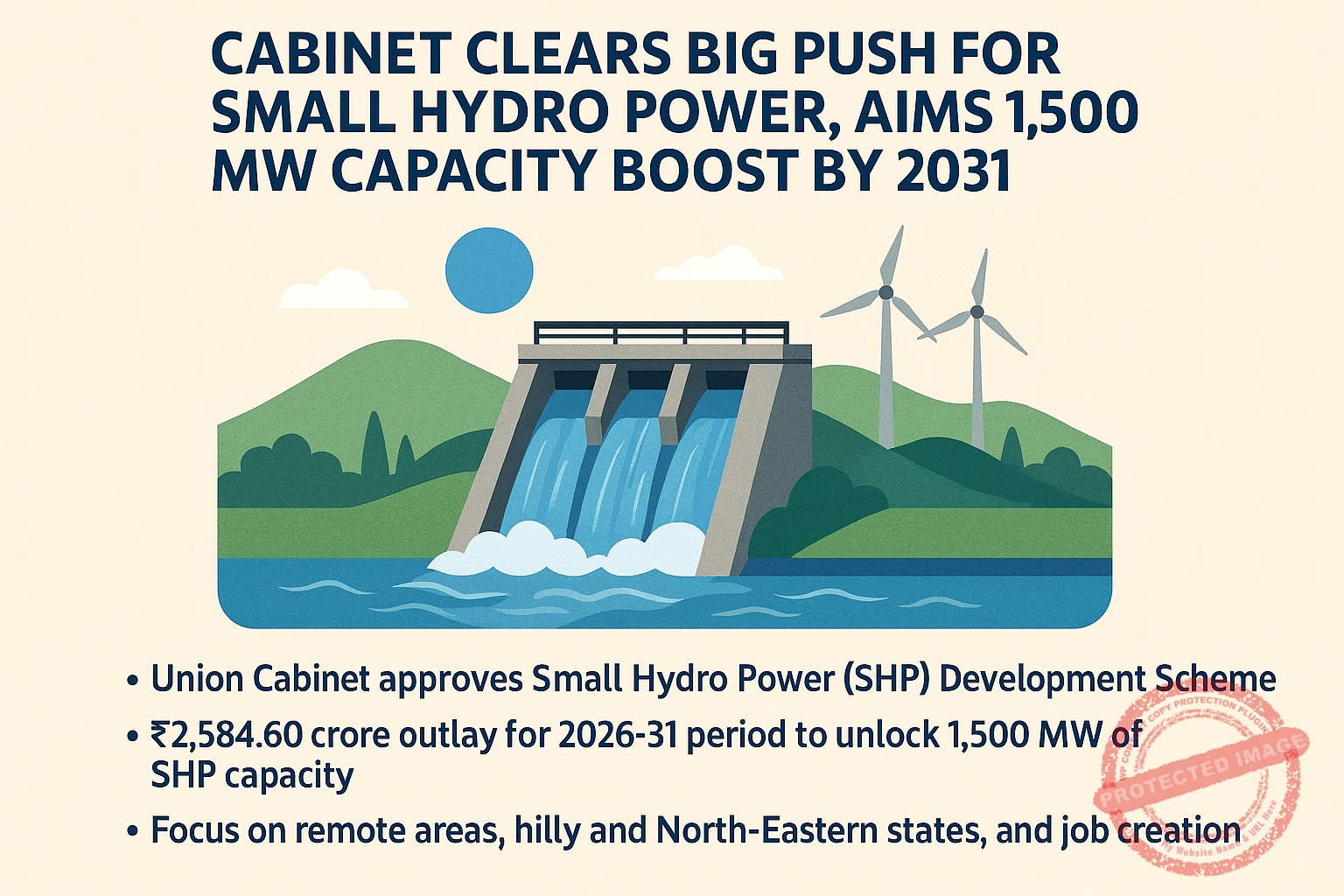
In a major step to strengthen India’s clean energy backbone, the Union Cabinet has approved the Small Hydro Power (SHP) Development Scheme for the period 2026–27 to 2030–31, with a total outlay of Rs 2,584.60 crore. The move is expected to unlock around 1,500 MW of new small hydro capacity, improve electricity access in remote areas, and create large-scale employment—especially in hilly and North-Eastern states.
Hydropower, generated from flowing water, is one of the oldest and most reliable renewable energy sources. Unlike solar and wind, which depend on weather conditions, hydropower can supply round-the-clock electricity and provide flexibility to the power grid. As India rapidly expands renewable energy, small hydro projects are increasingly seen as a dependable support system for grid stability and energy security.
Why Small Hydro Matters
Small hydro projects—those with a capacity of up to 25 MW—are particularly suited to India’s diverse geography. Located close to villages and small towns, they generate power near consumption centres, reducing transmission losses and ensuring a steady supply in remote and difficult terrains.
The Ministry of New and Renewable Energy (MNRE) handles these projects, while larger hydro projects fall under the Ministry of Power.
Focus on Hills and the North-East
The new scheme puts special emphasis on hilly regions and the North-Eastern States, where electricity access can be limited and dependence on diesel or long transmission lines remains high.
To improve project viability, the government has announced targeted financial assistance: Rs 3.6 crore per MW (or 30% of project cost, whichever is lower) for North-Eastern States and international border districts, capped at Rs 30 crore per project. Rs 2.4 crore per MW (or 20% of project cost) for projects in other regions, with a ceiling of Rs 20 crore per project. This support is expected to attract nearly Rs 15,000 crore of private and public investment, giving a strong boost to the small hydro sector.
Local Jobs and Local Growth
Beyond power generation, the scheme is expected to drive inclusive development. During the construction phase alone, it is projected to create around 51 lakh person-days of employment, with additional long-term jobs in operation and maintenance—mostly in rural and remote areas.
Small hydro projects typically have a low ecological footprint, require limited land, and avoid large-scale displacement. Many projects are run-of-the-river or canal-based, using existing water flows without building large dams, making them environment-friendly and socially acceptable.
Building a Strong Project Pipeline
To ensure steady growth beyond the next five years, the scheme also supports the preparation of Detailed Project Reports (DPRs) for at least 200 future projects. A separate allocation of Rs 30 crore has been made to help central and state agencies build a strong project pipeline.
The scheme also encourages the use of indigenous equipment and machinery, supporting domestic manufacturing and aligning with the government’s Atmanirbhar Bharat vision.
Huge Untapped Potential
India has an estimated small hydro potential of over 21,000 MW across more than 7,100 identified sites. So far, about 5,170 MW—roughly one-fourth—has been developed, leaving vast scope for expansion.
Northern India leads with nearly 38% of the potential, especially in Himachal Pradesh, Uttarakhand, Jammu & Kashmir, and Ladakh. The North-East holds around 15%, with Arunachal Pradesh emerging as a major hub. The Southern region, led by Karnataka, has strong infrastructure and higher utilisation levels. The Western and Eastern regions offer opportunities through canal-based and decentralised projects, particularly benefiting farming and tribal areas.
Powering India’s Clean Energy Future
With this fresh policy push, the government aims to position small hydro as a key pillar of India’s clean energy transition—combining reliability, sustainability, and regional equity.
By lighting up remote villages, strengthening the power grid, creating jobs, and reducing dependence on fossil fuels, the Small Hydro Power Development Scheme is set to play a quiet but crucial role in building a cleaner, stronger, and more self-reliant India.