










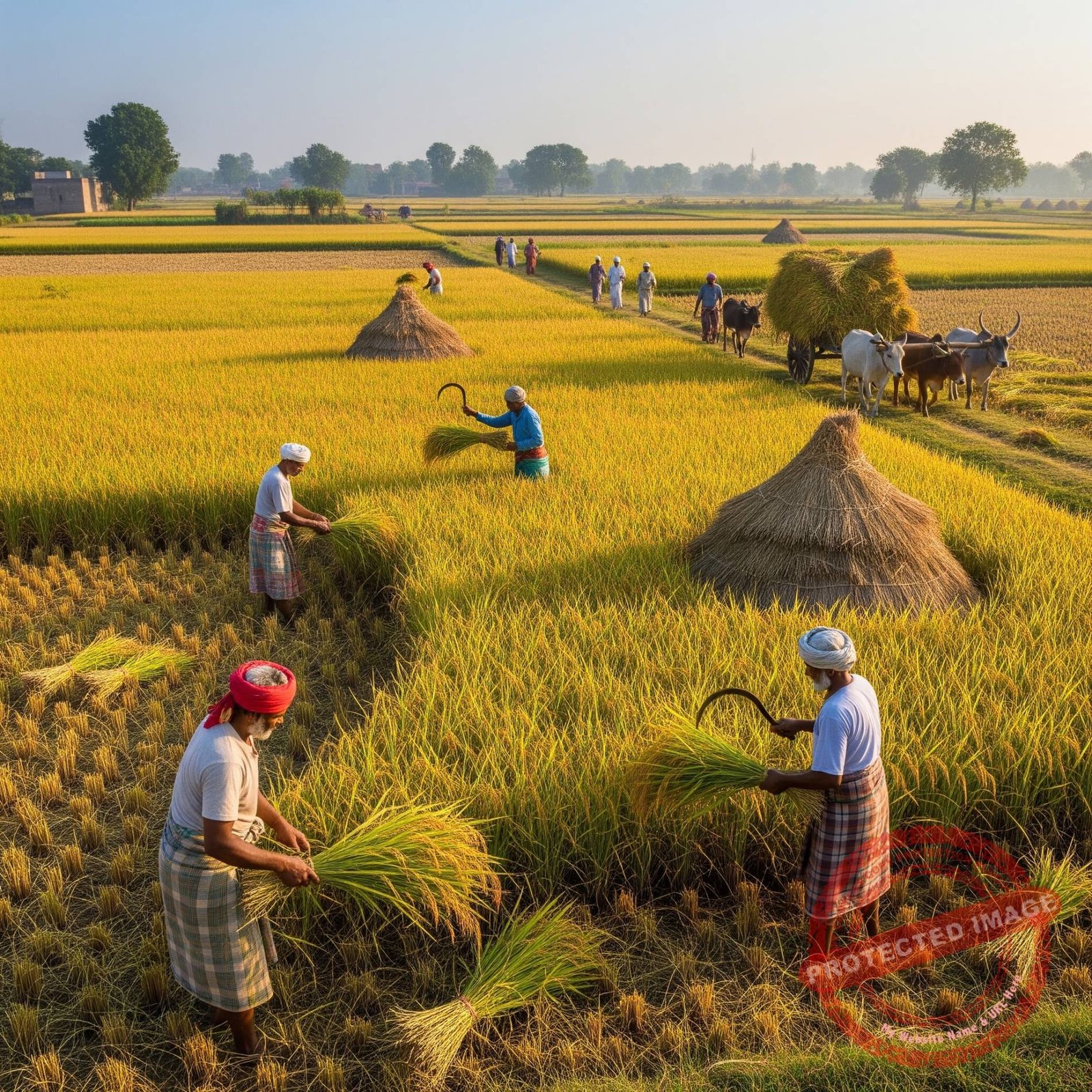
The area under cultivation and productivity of the indigenous Kalanamak rice variety have grown significantly in recent years, leading to a substantial increase in farmers’ income, the Centre informed Lok Sabha.
Minister of State for Agriculture and Farmers Welfare Bhagirath Choudhary, in a written reply, said that Kalanamak rice production in Uttar Pradesh’s Siddharthnagar district has increased by more than five times between 2018 and 2025. During the same period, the market price of Kalanamak rice rose from about Rs 40 per kg in 2018 to Rs 150 per kg in 2026, making it over three times more profitable than conventional rice varieties.
The growing profitability has encouraged more farmers to take up Kalanamak cultivation. The number of cultivators increased from 2,915 in 2018 to around 23,000 in 2024, he informed.
The minister said both the Centre and the Uttar Pradesh government have extended financial, technical and marketing support to Kalanamak farmers. Under the PM Formalisation of Micro Food Processing Enterprises (PMFME) scheme and the state-funded One District One Product (ODOP) Margin Money Scheme, individual micro-enterprises and Farmer Producer Organisations (FPOs) establishing Kalanamak processing and milling units are eligible for credit-linked capital subsidies of up to 35%, capped at Rs 10 lakh.
To strengthen branding and market visibility, governments have been organising Kalanamak Mahotsavs. A Common Facility Centre (CFC) has also been established in Siddharthnagar under the ODOP scheme, providing farmers access to modern processing, packaging and export-support infrastructure. Dedicated project funding has been earmarked by the state for promotion, production and processing of the speciality rice.
The National Agricultural Research System under the Indian Council of Agricultural Research (ICAR) has been engaged in the conservation of traditional Kalanamak germplasm and the development of improved varieties. Besides traditional strains, six improved varieties have been released and notified: KN3, Bauna Kalanamak 101, Bauna Kalanamak 102, Kalanamak Kiran, Pusa Narendra Kalanamak 1 and Pusa CRD Kalanamak 2.
According to the minister, the two recently developed dwarf varieties, Pusa Narendra Kalanamak 1 and Pusa CRD Kalanamak 2, yield an average of 4.5 tonnes per hectare, compared with about 2.5 tonnes per hectare from traditional varieties.
The Uttar Pradesh government has also designated Krishi Vigyan Kendras (KVKs) within the Geographical Indication (GI) region of Kalanamak rice for multi-location testing of climate-resilient, high-yielding varieties. ICAR institutions and KVKs are helping farmers register and conserve traditional rice varieties under the Protection of Plant Varieties and Farmers’ Rights Authority, resulting in the registration of more than 1,700 landraces and local rice varieties.
To support expansion of Kalanamak cultivation, the government has encouraged additional seed indents through the Breeder Seed Programme. Around 15-20 quintals of breeder seed are produced annually for multiplication into foundation and certified seeds. Over the last five years, from 2021-22 to 2025-26, a total of 389.6 quintals of quality Kalanamak seed has been produced and distributed among farmers.
The government is also promoting exports of Kalanamak rice through the Agricultural and Processed Food Products Export Development Authority (APEDA). Regional FPOs are being linked directly with international buyers, facilitating exports to markets such as Singapore and Nepal.
Marketed internationally as “Buddha Rice,” Kalanamak is being positioned in premium markets across Buddhist-majority nations including Japan, Thailand, Vietnam, Singapore and Myanmar. Siddharthnagar and neighbouring Terai districts have also been brought under APEDA’s Agri-Export Zone framework for speciality rice, enabling priority support for export packaging, residue testing and quarantine compliance.
The minister said these coordinated interventions have significantly strengthened production, processing, branding and export prospects of Kalanamak rice, benefiting farmers across the GI-designated region.