










At the southern tip of India, a quiet, forested island is being prepared for a transformation that could redraw the country’s maritime and economic map. The Great Nicobar Project aims to turn Great Nicobar into a strategic hub for trade, security and sustainable development—while pledging strong safeguards for its fragile ecology and indigenous communities.
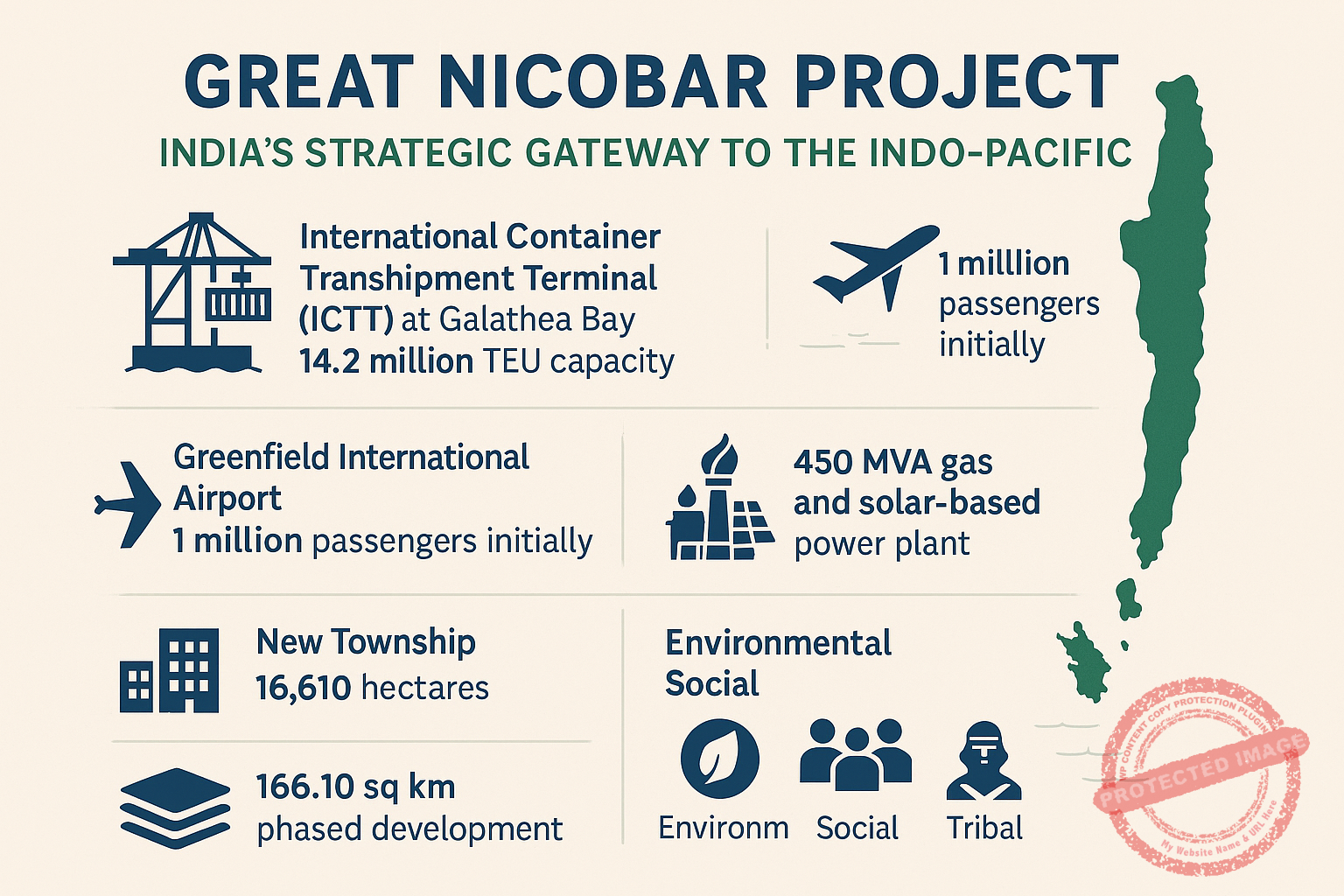
At the heart of the project is the International Container Transhipment Terminal (ICTT) at Galathea Bay, designed for a capacity of 14.2 million TEU.
With natural water depth exceeding 20 metres and location just 40 nautical miles from the East–West international shipping lane, the port is positioned to attract large container ships that India’s current ports cannot handle.
Today, the absence of deep-water berths forces Indian cargo to be routed through foreign ports such as Colombo, Singapore and Klang—resulting in revenue losses and strategic dependence. With countries like China, Sri Lanka and Myanmar rapidly expanding their port infrastructure, the Galathea Bay port is envisioned as India’s answer to this gap, strengthening both trade competitiveness and national security in the Indian Ocean Region.
The port is part of a broader, integrated development plan that includes a greenfield international airport, a gas-and-solar-based 450 MVA power plant, and a new township spanning 16,610 hectares. The airport, initially designed to handle 1 million passengers annually, is expected to expand to 10 million passengers per year, opening Great Nicobar to tourism and regional connectivity. Its proximity to global tourist hubs like Phuket, Langkawi and Southeast Asian cities gives it added advantage.
Reliable power supply is central to the project. At present, the Andaman and Nicobar Islands depend heavily on diesel generators. The proposed hybrid power plant aims to ensure uninterrupted electricity for the port, airport and township, while reducing carbon emissions and improving resilience.
Development will be carried out in three phases between 2025 and 2047, covering a total of 166.10 square kilometres. This includes 35.35 sq km of revenue land and 130.75 sq km of forest land, with careful phasing to integrate environmental and social safeguards at every stage.
The project has received prior Environmental Clearance under the EIA Notification, 2006, following screening, scoping, public consultation and expert appraisal. The clearance comes with 42 binding conditions covering air and water quality, waste management, marine ecology, disaster preparedness and human health. Leading institutions such as the Zoological Survey of India, Wildlife Institute of India, IISc and SACON have conducted scientific studies, concluding that the project can proceed with appropriate safeguards.
Three independent monitoring committees will oversee pollution control, biodiversity protection, and the welfare of the Shompen and Nicobarese tribes, along with an overarching committee chaired by the Chief Secretary of the Andaman and Nicobar Administration to ensure coordinated implementation.
Forest diversion will amount to 1.82% of the islands’ total forest cover. While up to 7.11 lakh trees may be felled in phases, 65.99 sq km will be preserved as green zones. Compensatory afforestation is planned on 97.30 sq km in Haryana, and 2.4 million trees have already been planted locally under the “Ek Ped Maa Ke Naam” initiative.
Crucially, the project does not involve displacement of tribal communities. The plan aligns with the Shompen Policy 2015 and constitutional safeguards for Particularly Vulnerable Tribal Groups. Though part of the project overlaps with tribal reserve land, the government has re-notified additional areas—resulting in a net increase of tribal reserve by 3.9 sq km.
Located in a seismic and cyclone-prone zone, the island will also benefit from a comprehensive disaster and risk management framework covering earthquakes, tsunamis, cyclones and industrial hazards.
Taken together, the Great Nicobar Project seeks to present a new model of development—one where strategic ambition, economic growth and ecological responsibility move forward together, placing India firmly on the global maritime map without losing sight of the island’s people and natural heritage.