










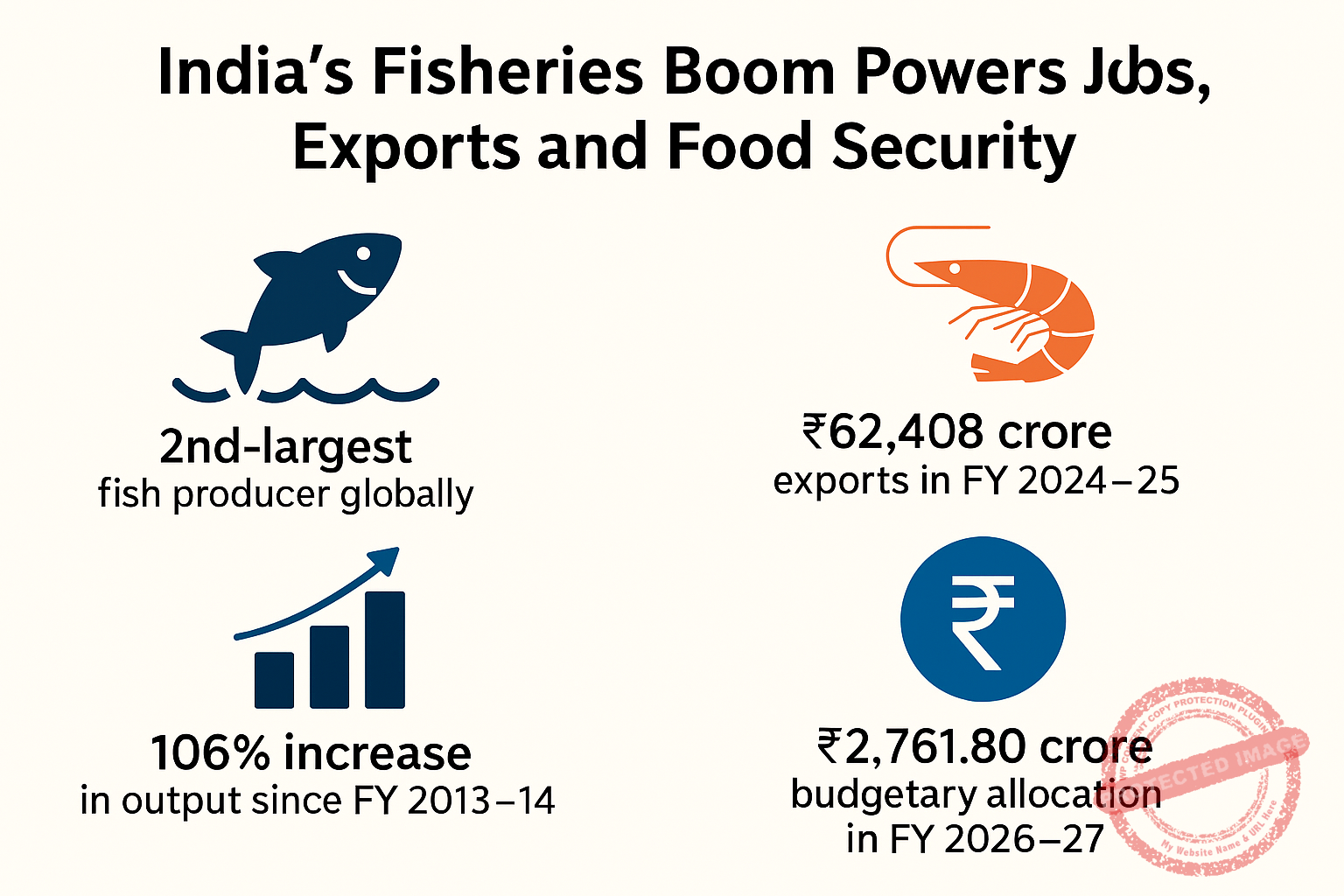
From fishing harbours along the coastline to fish ponds in remote villages, India’s fisheries sector is riding a strong wave of growth. Now the world’s second‑largest fish‑producing nation, India accounts for about eight per cent of global output—a rise that reflects not just higher production, but a deep transformation driven by focused policy support, modern infrastructure and technology-led practices.
Fisheries has emerged as one of the strongest pillars of India’s agricultural economy. It contributes around 7.43 per cent to Agricultural Gross Value Added, the highest share among all agriculture and allied sectors, underlining its importance for food security, jobs and rural incomes. This growing role is especially evident in coastal and inland regions, where fisheries support millions of livelihoods.
Government interventions over the past decade have significantly boosted output. India’s total fish production more than doubled from 95.79 lakh tonnes in 2013–14 to 197.75 lakh tonnes in 2024–25, an increase of 106 per cent. Alongside production, exports have also expanded sharply. Seafood exports touched Rs 62,408 crore in 2024–25, with frozen shrimp remaining the top export product. The United States and China continue to be major destinations, highlighting India’s rising global competitiveness in seafood trade.
The sector’s growing strategic importance has been strongly reflected in public spending. The Union Budget 2026–27 has proposed a record allocation of Rs 2,761.80 crore for fisheries, the highest ever. Of this, Rs 2,530 crore has been earmarked for major government schemes that provide financial assistance, capital subsidies, insurance cover, skills training, infrastructure support and welfare measures, directly targeting fishers and fish farmers.
Since the launch of the Blue Revolution in 2015, India’s fisheries sector has shifted from largely traditional practices to a more organised and value‑chain‑oriented framework. Investments in fishing harbours, landing centres, cold chains, processing units, deep-sea fishing vessels and advanced aquaculture systems have strengthened productivity as well as exports. This shift has brought fisheries closer to the goals of sustainability, income stability and global market integration.
Institution-building has been a key focus. According to the Economic Survey 2025–26, as many as 2,195 Fisheries Farmer Producer Organizations have been formed, supported by an investment of Rs 544 crore. These collectives improve market access, bargaining power and financial inclusion for fishers. In addition, nutritional and livelihood support during fishing bans and lean seasons has benefited around 4.33 lakh fisher families, with an expenditure of Rs 1,681.21 crore, providing much-needed income security.
Employment generation has been one of the most significant outcomes of this expansion. Fisheries-related schemes implemented since 2014–15 have created an estimated 74.66 lakh direct and indirect jobs, reinforcing the sector’s role in inclusive economic growth.
Policy evolution over the years shows a clear progression from boosting production to strengthening governance, digitisation and sustainability. After the Blue Revolution, the Fisheries and Aquaculture Infrastructure Development Fund was introduced in 2018–19 to bridge critical infrastructure gaps. Access to institutional credit improved when the Kisan Credit Card was extended to fishers in 2019. The launch of the Pradhan Mantri Matsya Sampada Yojana in 2020 marked a major turning point, offering a comprehensive framework for production growth, infrastructure creation and value chain development.
Subsequent initiatives focused on modern aquaculture practices, formalisation and financial inclusion. The Pradhan Mantri Matsya Kisan Samridhi Sah‑Yojana introduced insurance and greater financial support, while digital tools such as the National Fisheries Digital Platform and the Marine Fisheries Census improved transparency and planning. In 2025, the notification of Sustainable Fisheries Rules for the Exclusive Economic Zone and high seas reinforced conservation, regulatory compliance and long-term resource management.
At the heart of this transformation is PMMSY, which continues to anchor fisheries development with a proposed allocation of Rs 2,500 crore in 2026–27. As of early March 2026, the scheme has approved large-scale activities including inland aquaculture ponds, reservoir cage culture, fish transportation units, value-added enterprises such as ice plants and cold storages, and thousands of fish markets and kiosks. These efforts strengthen every link of the fisheries value chain, from production to consumer.
The scheme also encourages technology-driven aquaculture such as Recirculatory Aquaculture Systems and bio‑floc technology, which increase output while saving water and reducing environmental stress. Together, these measures are help ing transform fisheries into a resilient, sustainable and globally competitive sector.
As India continues to integrate fisheries into its broader growth and sustainability agenda, the sector is no longer seen as peripheral. Instead, it is fast emerging as a driver of nutrition, livelihoods, exports and economic resilience—securing both the nets and the future of millions who depend on it.