










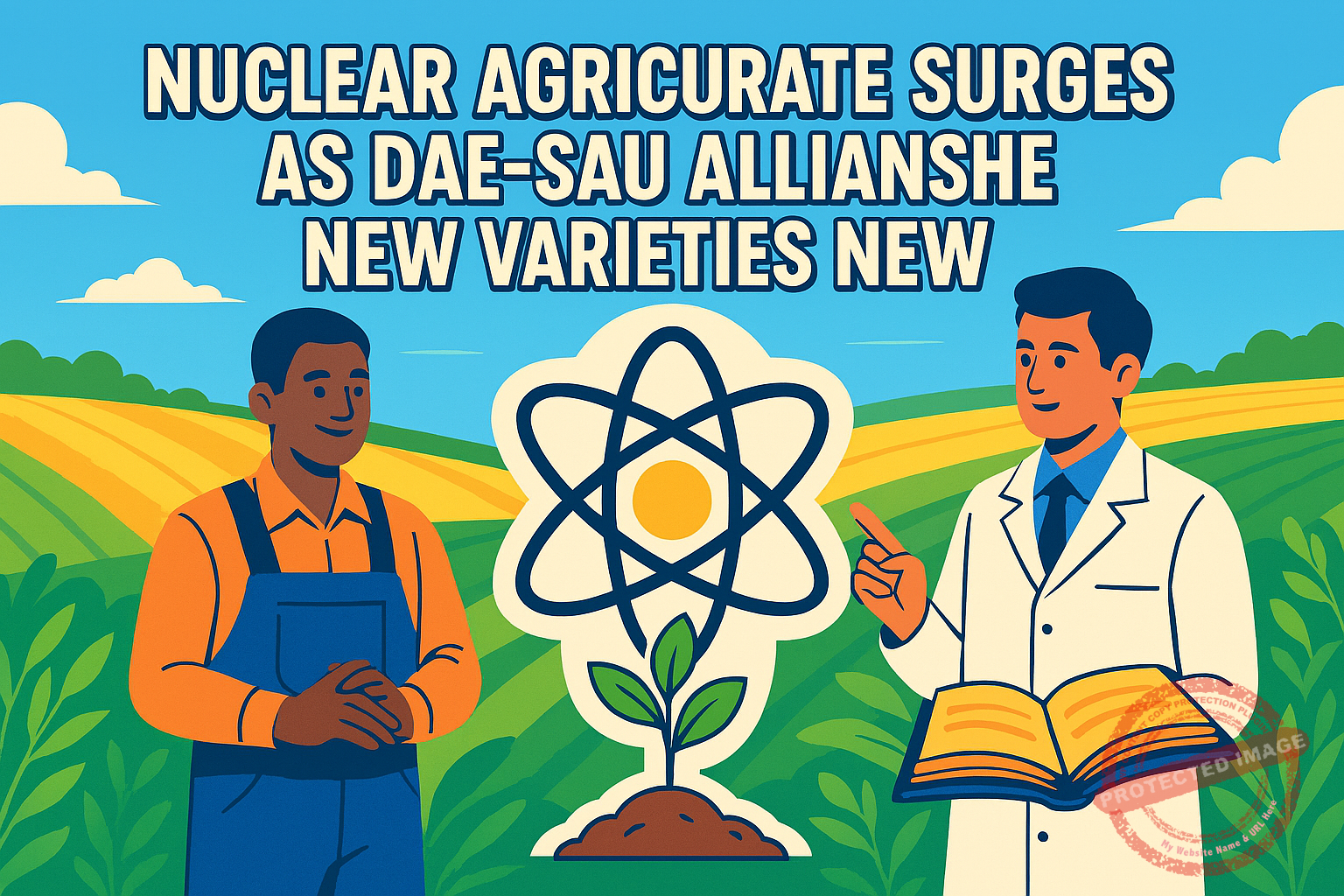
The Department of Atomic Energy (DAE) has undertaken several initiatives to promote the adoption of nuclear agricultural technologies in partnership with State Agricultural Universities (SAUs) and research institutions, with the objective of enhancing farmers’ incomes and strengthening the nation’s food security. As part of this effort, the Bhabha Atomic Research Centre (BARC), a premier unit of DAE, has entered into numerous Memoranda of Understanding (MoUs) with SAUs to support nuclear agricultural research, field validation and the dissemination of improved crop varieties.
Under its mutation breeding programme, BARC develops mutant crop lines using gamma irradiation and other mutagens. Promising lines are shared with SAUs and research institutes for multi‑location trials, where they are evaluated for improved traits in comparison with existing varieties and tested through screening and adaptive trials. Successful lines are subsequently released for cultivation on farmers’ fields. Many of the widely adopted Trombay crop varieties have been officially released following such collaborative evaluations with SAUs. Through their seed multiplication networks and breeder seed production systems, SAUs play a crucial role in distributing these varieties to cultivators, while BARC continues to provide nucleus seed and technical support.
BARC offers advanced scientific facilities and expertise to its partner institutions, including access to irradiation units such as gamma chambers, molecular biology laboratories, isotope tracer facilities and radiometric analysis tools for soil‑water‑plant studies. Faculty members and postgraduate researchers from SAUs and other institutions frequently carry out part of their research work at BARC under joint projects, benefiting from the centre’s high‑end scientific infrastructure.
In the area of agro‑technologies, BARC works closely with SAUs and research organisations to conduct field demonstrations and farmer‑participatory trials. While universities assess the performance of these technologies under local farming conditions, BARC provides technical guidance and scientific know‑how. The collaboration is further strengthened through training programmes, workshops and technology‑transfer initiatives, including specialised courses on mutation breeding, radiation processing and advanced biotechnology. Scientists and students from SAUs regularly receive training at BARC, contributing to national capacity building in nuclear agricultural sciences. DAE also participates in agricultural fairs and Krishi Melas organised by SAUs and research institutions to showcase new crop varieties and technologies developed by BARC.
Additionally, the Board of Research in Nuclear Sciences (BRNS), the R&D funding arm of DAE, supports SAUs through competitive research grants, infrastructure development and capacity‑building initiatives in nuclear and allied sciences relevant to agriculture. BRNS provides extramural research funding for projects in mutation breeding, molecular biology, radiation processing, isotope tracer studies, soil‑water‑plant interactions, food irradiation, biocontrol technologies and the procurement of scientific equipment required for advanced research. These projects often lead to the development of new crop mutants, stress‑tolerant lines and agro‑technologies, which are then tested, released and disseminated to farmers by SAUs and research institutes.