










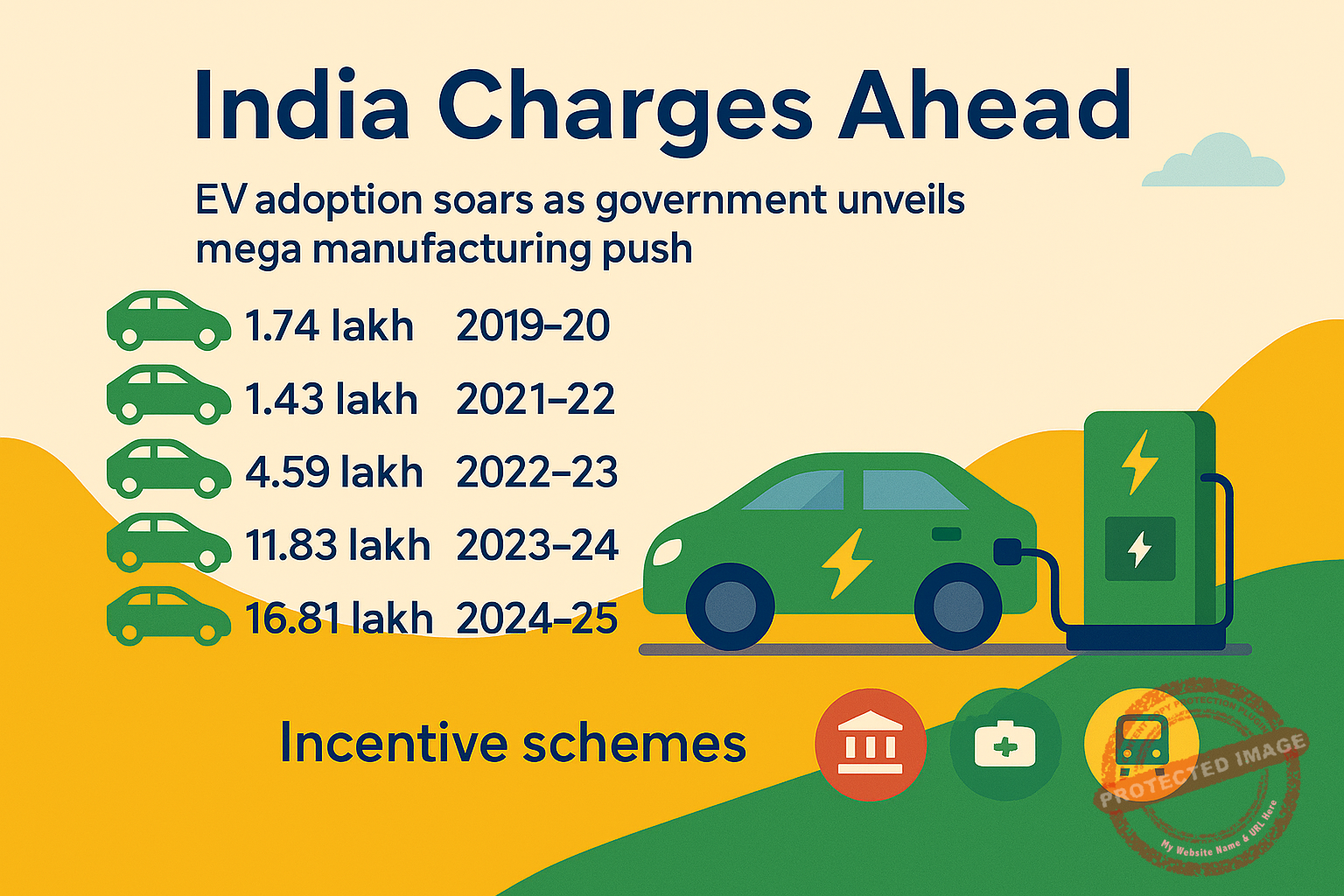
The Ministry of Heavy Industries (MHI) has reported a consistent and significant increase in the adoption of electric vehicles (EVs) across the country over the past six financial years. As per data available on the VAHAN portal, EV usage rose from 1.74 lakh in 2019–20 to 1.43 lakh in 2020–21, followed by a sharp increase to 4.59 lakh in 2021–22. This growth continued with 11.83 lakh EVs in 2022–23, 16.81 lakh in 2023–24, and reached 19.68 lakh registered electric vehicles in 2024–25, underscoring India’s accelerating shift toward sustainable mobility.
To support this momentum, the Ministry has launched a range of initiatives to strengthen domestic manufacturing and enhance supply chain resilience. Among these is the Production Linked Incentive Scheme for Automobile and Auto Component Industry (PLI‑Auto), aimed at boosting India’s capacity to manufacture Advanced Automotive Technology products with a minimum domestic value addition of 50 percent. The scheme carries a budgetary outlay of Rs 25,938 crore and seeks to attract substantial investments across the automotive value chain. Complementing this is the Production Linked Incentive Scheme for Advanced Chemistry Cell (ACC) Battery Storage, with an outlay of Rs 18,100 crore, which aims to establish a cumulative battery manufacturing capacity of 50 GWh in the country.
Further strengthening India’s electric mobility ecosystem, the Government has launched the PM Electric Drive Revolution in Innovative Vehicle Enhancement (PM E‑DRIVE) Scheme with a financial allocation of Rs 10,900 crore for the period 2024 to 2028. The scheme incentivises the purchase of electric two‑wheelers, three‑wheelers, ambulances, trucks, and buses, while also supporting the expansion of charging infrastructure and the upgradation of vehicle testing facilities. A Phased Manufacturing Programme under this scheme mandates domestic production of critical EV components to promote self‑reliance.
The Government has also notified the Scheme to Promote Manufacturing of Sintered Rare Earth Permanent Magnets (REPM Scheme) with an outlay of Rs 7,280 crore. This initiative seeks to establish an annual production capacity of 6,000 metric tons of integrated Rare Earth Permanent Magnets in India, reducing dependence on imports and strengthening the country’s position in the global magnet manufacturing market.
In addition, the PM e‑Bus Sewa – Payment Security Mechanism (PSM) Scheme, with a total allocation of Rs 3,435.33 crore, aims to support the deployment of more than 38,000 electric buses nationwide. The mechanism is designed to ensure payment security for e‑bus operators in the event of delays or defaults by Public Transport Authorities, facilitating smooth implementation of electric public transport systems.
To further scale the domestic EV ecosystem, the Government has introduced the Scheme for Promotion of Manufacturing Electric Passenger Cars in India (SPMEPCI). The scheme mandates a minimum investment of Rs 4,150 crore and requires manufacturers to achieve a domestic value addition of 25 percent by the third year and 50 percent by the fifth year of operations.
Through these coordinated policy measures and financial incentives, the Government of India reaffirms its commitment to strengthening the country’s electric mobility landscape, building domestic manufacturing capacity, and advancing India toward a cleaner, self‑reliant and future‑ready transportation system.