










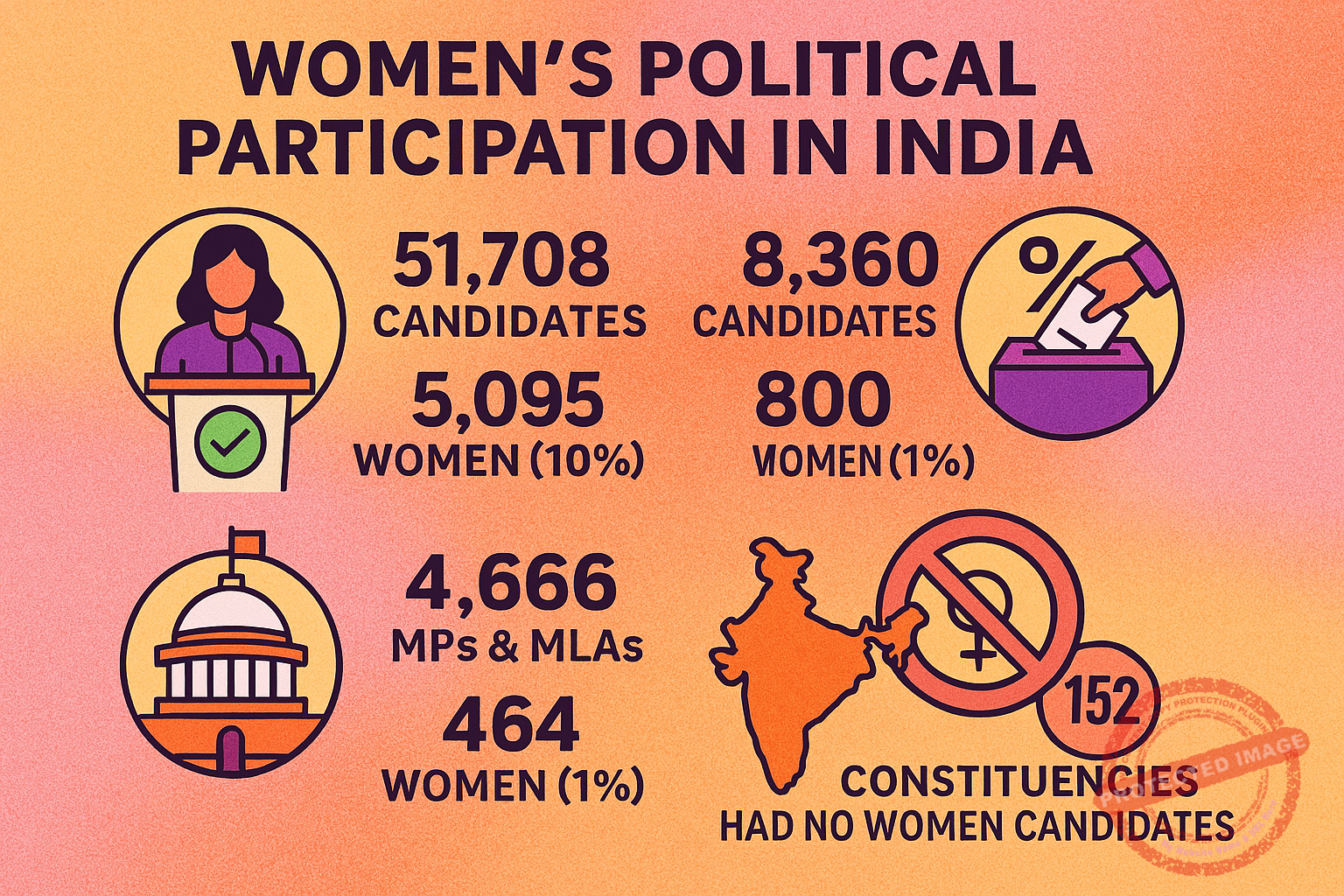
The latest report by the Association for Democratic Reforms (ADR) and National Election Watch delivered a stark reminder of how far India still has to go in ensuring gender equality in politics. The study, released on March 8, examined 51,708 candidates who contested the current Lok Sabha and State/UT Assembly elections and found that just 5,095—only 10 percent—were women. The pattern persisted among elected representatives: of 4,666 MPs and MLAs across the country, only 464 are women, mirroring the same 10 percent share.
Revealing the sobering numbers, ADR analysis showed how deeply entrenched the barriers remain. It also underscored the urgency of operationalising the Constitution (One Hundred and Twenty-Eighth Amendment) Bill, 2023, the landmark legislation that promises to reserve one-third of all seats in Parliament and state legislatures for women.
The findings from the 2024 Lok Sabha elections were especially illuminating. Out of 8,360 candidates in the fray, only 800 were women, and 152 constituencies did not feature a single female contender. A few pockets stood out—Baramati in Maharashtra and Secunderabad in Telangana saw relatively high female participation—but they were the exception in an otherwise male-dominated landscape.
Among national parties, the BJP topped the list with 16 percent women candidates, followed by the Congress and CPI(M) with 13 percent each. In striking contrast, the Aam Aadmi Party did not field a single woman among its 22 candidates.
State assemblies fared no better. Of 43,348 candidates analysed, only 4,295 were women, and in 41 percent of assembly constituencies, not a single woman contested. No state managed to cross even a modest 15 percent representation. Odisha and Delhi came closest with 14 percent women candidates each, while Nagaland, Arunachal Pradesh, and Jammu & Kashmir languished at the bottom, registering between 2 and 5 percent. Andhra Pradesh’s Guntur West was a rare outlier, with 12 women in the fray—the highest for any assembly seat.
The report also highlighted striking variations across political parties. The Biju Janata Dal (BJD) emerged as a notable performer, fielding 25 percent women candidates, while the All India Trinamool Congress (AITC) managed 15 percent. At the lower end, parties such as AIMIM and CPI fielded just 5 percent women, and many regional outfits fielded none at all. Independent candidates didn’t improve the picture either: only a little over 8 percent were women.
Taken together, ADR’s analysis paints a clear, if troubling, portrait of systemic underrepresentation. Despite decades of debate, legislative proposals, and public advocacy, women’s participation in electoral politics remains limited both in terms of candidacy and actual representation. The report concludes that without structural reforms—most notably the long-delayed women’s reservation law—gender parity in India’s legislatures will remain a distant aspiration.
“Out of a total of 51,708 candidates analysed who contested in the current Lok Sabha and Assembly elections across the country, only 5,095 (10%) are women. Among 4,666 MPs/MLAs across the country, only 464 or 10% are women,” ADR observed in its concluding note. Released on a day dedicated to celebrating women’s achievements, the numbers serve less as a celebration and more as a call to action—an urgent reminder that India’s democracy can only be strengthened when its institutions truly reflect the diversity of the people they represent.