










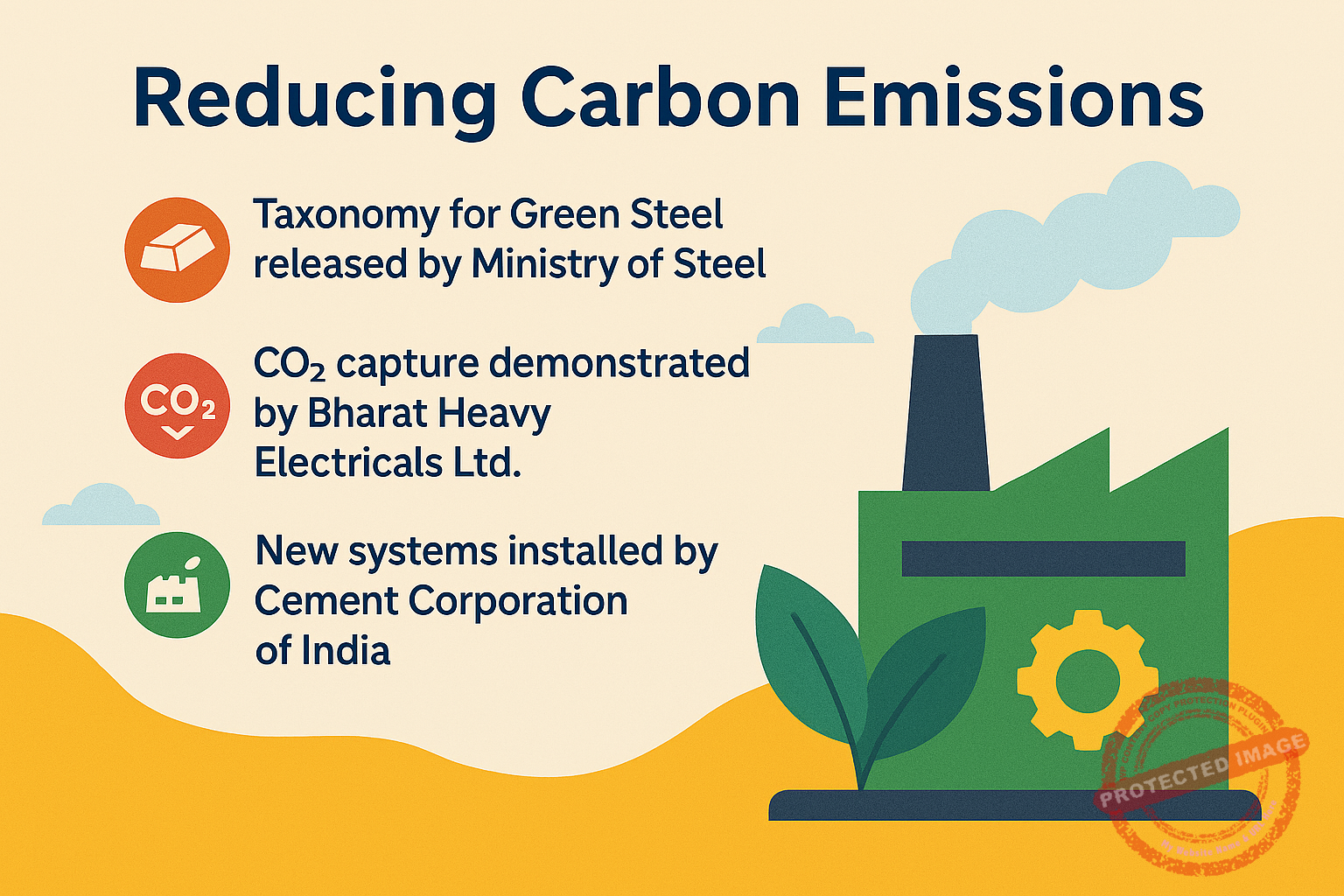
The Ministry of Steel (MoS) has undertaken a series of major initiatives aimed at reducing carbon emissions and accelerating India’s transition toward greener industrial practices. As part of these efforts, the Ministry has released the Taxonomy for Green Steel, establishing clear standards for defining and categorizing low‑emission steel. Additionally, the Ministry has issued a comprehensive report titled “Greening the Steel Sector in India: Roadmap and Action Plan,” developed in alignment with recommendations from the 14 Task Forces constituted by MoS.
This roadmap outlines the long-term pathway for green steel production and sustainability, supporting India’s commitment to achieving net‑zero emissions by 2070. The report is available on the Ministry of Steel’s website.
Further, to promote the use of recycled materials, the Steel Scrap Recycling Policy 2019 continues to provide an inter‑ministerial coordination framework for managing and facilitating the recycling of ferrous scrap from various sources. In support of the National Green Hydrogen Mission, four pilot projects involving the use of hydrogen in steelmaking have also been launched under the Ministry of New & Renewable Energy.
Public sector undertakings under the Ministry of Heavy Industries have also adopted significant in‑house measures to curb CO₂ emissions. Bharat Heavy Electricals Limited (BHEL) has successfully demonstrated its indigenous CO₂ capture technology through a 1.4 TPD capture unit, integrated with its 0.25 TPD coal‑to‑methanol pilot plant, using an amine-based absorption method.
Moreover, the Advanced Ultra Supercritical (AUSC) technology—developed jointly by BHEL, NTPC, and IGCAR—offers best‑in‑class efficiency in coal‑based power generation, reducing CO₂ emissions by approximately 11% compared with conventional Supercritical power plants. BHEL has also installed around 35 MW of solar power capacity across its manufacturing units nationwide.
In the cement sector, the Cement Corporation of India (CCI) has taken multiple steps to reduce carbon emissions, including installing a Fly Ash Feeding System, hot air ducting, and upgrading outdated motors. Solar power plants have also been installed under the RESCO mode to support clean-energy integration at CCI units.
The Government of India remains committed to advancing low‑carbon technologies and strengthening sustainable industrial practices across key sectors to support the nation’s long-term climate goals.