










Child marriage continues to remain one of India’s most deep‑seated social challenges despite decades of legal reform and widespread awareness campaigns. Millions of minors—mostly girls—are still pushed into early marriages, exposing them to serious health complications, curtailed education, and lifelong socio-economic vulnerability. According to the National Family Health Survey-5 (2019–21), 23% of women aged 20–24 were married before turning 18, underscoring the persistent nature of the problem.
States such as West Bengal, Uttar Pradesh, and Bihar report some of the highest instances of child marriage, but experts stress the practice is visible nationwide, including in urban pockets where it is often concealed.
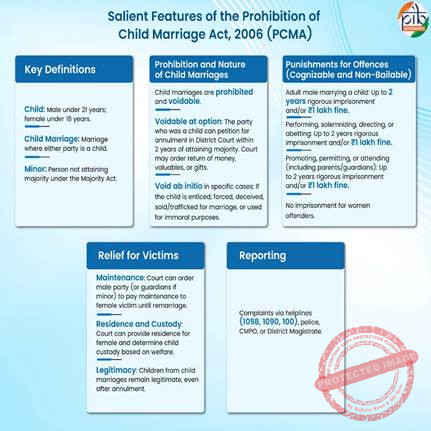
Under the Prohibition of Child Marriage Act (PCMA), 2006, the minimum legal age of marriage remains 18 for women and 21 for men. Any marriage below this threshold is a punishable offence. Legal provisions have been strengthened further where under the Bharatiya Nyaya Sanhita (BNS), 2023, any sexual act with a wife under 18 is classified as rape besides the Supreme Court has ruled that such acts amount to aggravated penetrative sexual assault under the POCSO Act, 2012, carrying severe penalties.
Health experts warn that early pregnancy leads to higher risks of maternal mortality, anaemia, and reproductive complications, while social workers highlight the link between child marriage and school dropouts and economic dependence.
A Century-Long Battle for Reform
India’s resistance to child marriage dates back to the 19th century, led by social reformers including Raja Rammohan Roy, Ishwar Chandra Vidyasagar, and Mahatma Jyotirao Phule. Their efforts paved the way for early protective laws such as Age of Consent Act, 1891 and the Child Marriage Restraint Act (Sarda Act), 1929 (minimum marriage age: 14 for girls, 18 for boys)
Subsequent amendments in 1948, 1978, and finally the PCMA, 2006, raised age limits and introduced stricter enforcement mechanisms. In more recent years, government campaigns such as Beti Bachao Beti Padhao (2015) have aimed to shift public attitudes and promote girls’ education.
Supreme Court’s landmark 2024 judgment pushes states to act
In a significant ruling on 18 October 2024, the Supreme Court, in Society for Enlightenment and Voluntary Action vs. Union of India, issued a sweeping framework to strengthen nationwide action against child marriage. It ordered full-time Child Marriage Prohibition Officers (CMPOs) at district and sub-district levels besides Special Child Marriage Prohibition Units dedicated to coordination and grievance handling.
Some of the Mandatory Preventive Measures brought into effect include multi-sectoral awareness drives involving schools, Anganwadis, NGOs, and religious leaders, training for police officials, teachers, judicial officers, and health workers, technology-enabled real-time reporting systems and maintenance of data sets identifying high-risk zones.
The Court also urged the government to explicitly prohibit child betrothals, arguing that engagements too often lead to forced marriages. The verdict marks a shift from punitive action toward prevention, protection, and empowerment.
Bal Vivah Mukt Bharat: A Renewed National Push
On 27 November 2024, the Ministry of Women and Child Development launched Bal Vivah Mukt Bharat (Child Marriage Free India)—a mission aligned with UN SDG 5.3, which aims to eliminate child marriage by 2030.
Its core pillars include technology-driven monitoring platforms, community-based vigilance and reporting systems, strengthening of child protection structures and coordinated efforts involving local administration, police, and civil society.
Officials say the mission goes beyond earlier initiatives by adopting a results-driven, integrated strategy.
The Road Ahead: Social Norms Still Pose the Biggest Barrier
Despite stronger laws and renewed national momentum, deeply ingrained social norms, poverty, dowry pressures, and gender discrimination continue to fuel child marriage across India.
Experts believe meaningful progress depends on strong political will, community involvement, sustained grassroots awareness and consistent enforcement of laws.
As India looks toward its 2030 target under the Sustainable Development Goals, activists and policymakers stress that ending child marriage is not merely a legal requirement but a moral obligation—critical to safeguarding children’s rights, health, and futures.
Collective Momentum toward a Child Marriage-Free India
With millions nationwide joining pledge campaigns and communities increasingly rejecting outdated customs, India is experiencing a growing wave of awareness and accountability. Experts note that Chhattisgarh’s progress demonstrates how a mix of political will, community empowerment, and technology can break longstanding cycles of inequality.
As India works toward building a Viksit Bharat (developed nation), the protection of every child’s right to education, health, and choice is emerging as a central priority.
The journey ahead remains challenging—but the successes in Balod and Surajpur serve as powerful reminders that a child marriage-free India is not only imaginable, but achievable with sustained collective action.