










A decade-long study of the unusual blazar OJ 287 has provided new insights into the behavior of its two supermassive black holes and the powerful jets produced by the distant cosmic system.
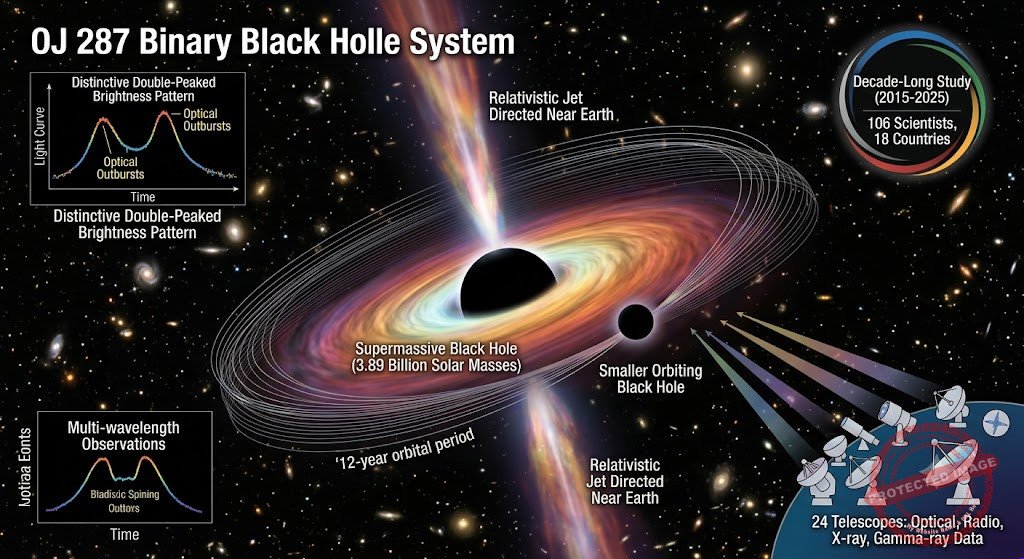
Located about four billion light-years from Earth, OJ 287 contains two supermassive black holes orbiting each other roughly once every 12 years. It is also a blazar, producing powerful jets of plasma traveling close to the speed of light and pointing towards Earth. Its emissions can be detected across the electromagnetic spectrum, from radio waves to gamma rays.
OJ 287 is known for a distinctive double-peaked pattern in its brightness. Scientists identified the periodic behavior in 1988 after studying nearly a century of optical observations dating back to 1880. Astronomers have since continued monitoring the object to better understand its orbital cycle.
The latest international study was coordinated by scientists from the Aryabhatta Research Institute of Observational Sciences (ARIES), Nainital, an autonomous institute under the Department of Science and Technology.
Led by Dr Alok C. Gupta of ARIES, the project involved 106 scientists from 18 countries and 48 research institutions and universities. Researchers used around two dozen telescopes to monitor OJ 287 between 2015 and 2025, including its latest major optical outbursts.
The campaign produced what researchers describe as the most extensive and densely sampled optical time-series observations of OJ 287 in about 150 years. Observations from ground- and space-based telescopes at other wavelengths supplemented the optical data.
Scientists examined changes in the blazar over different timescales, ranging from variations lasting several years to much faster fluctuations in its brightness.
The observations also helped researchers study the relative positions of the two black holes, changes in OJ 287’s brightness, spectrum and polarization, and possible signs of emissions associated with the smaller black hole.
The research builds on a series of studies led by Dr Gupta and Prof Mauri J. Valtonen of the University of Turku, Finland, since 2017.
Researchers also analyzed eight optical spectra recorded by Steward Observatory in the US during a relatively faint phase of OJ 287 between October 21 and November 22, 2017. Using the width of the emission line, they estimated the central black hole’s mass to be at least 3.89 billion times that of the Sun.
The findings could also contribute to multimessenger astronomy, which combines information from different cosmic signals, including electromagnetic radiation, gravitational waves, neutrinos and cosmic rays.
Researchers say continued monitoring of OJ 287 at different wavelengths could improve understanding of relativistic jets, supermassive binary black holes and possible links between electromagnetic and gravitational-wave signals.