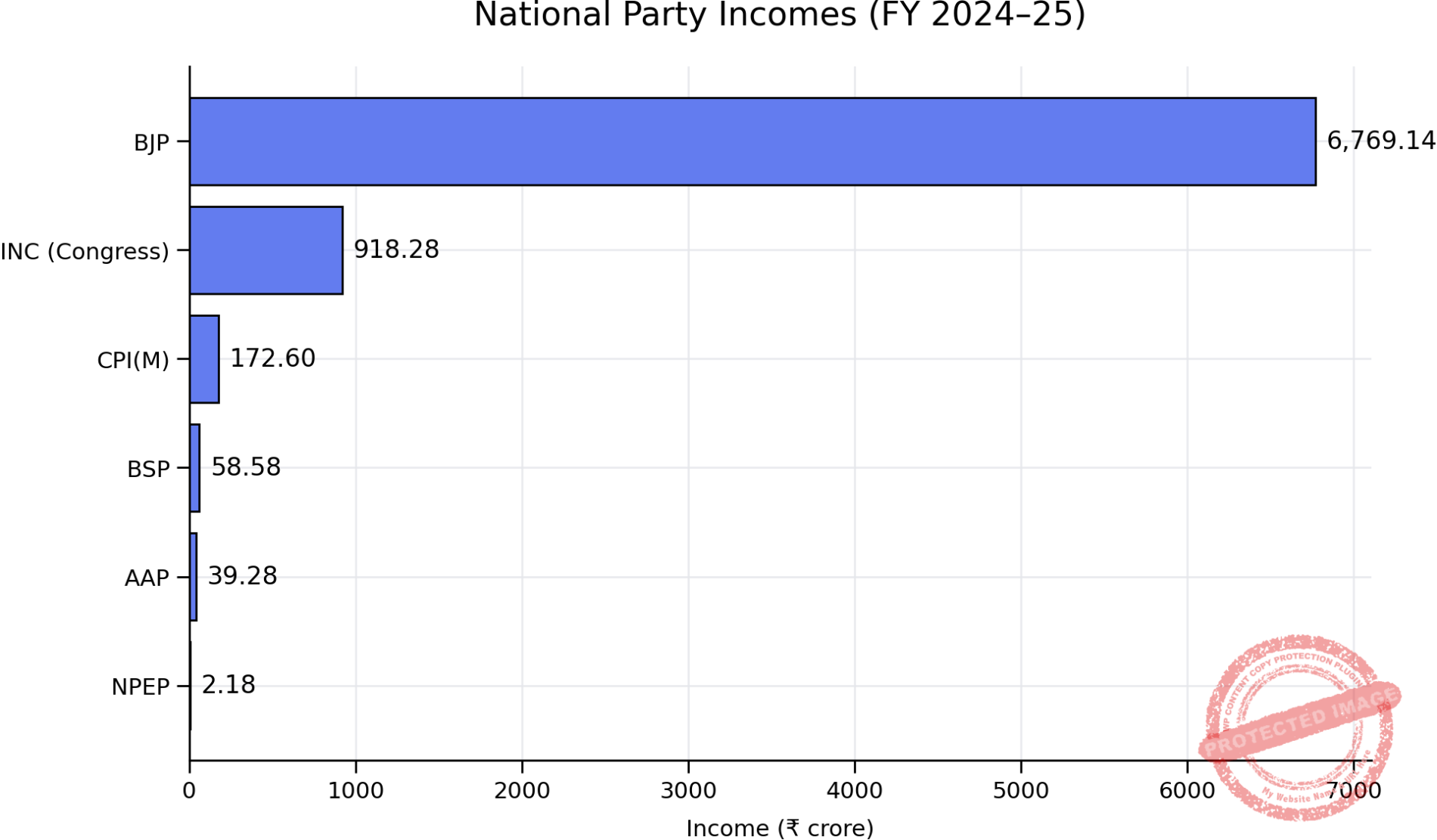
The Bharatiya Janata Party has once again emerged as the country’s financial powerhouse, declaring an income of ₹6,769.14 crore for the financial year 2024–25—an amount that dwarfs every other national party by a wide margin. The Congress, which reported Rs 918.28 crore for the same period, came in a distant second. The figures were released in a new analysis by the Association for Democratic Reforms (ADR), based on audited financial declarations submitted to the Election Commission.
Together, six national parties—the BJP, Congress, CPI(M), AAP, BSP and the National People’s Party (NPEP)—reported a combined income of Rs 7,960.09 crore. The BJP alone accounted for a staggering 85 percent of this total, further consolidating its position as the most financially dominant political force in India.
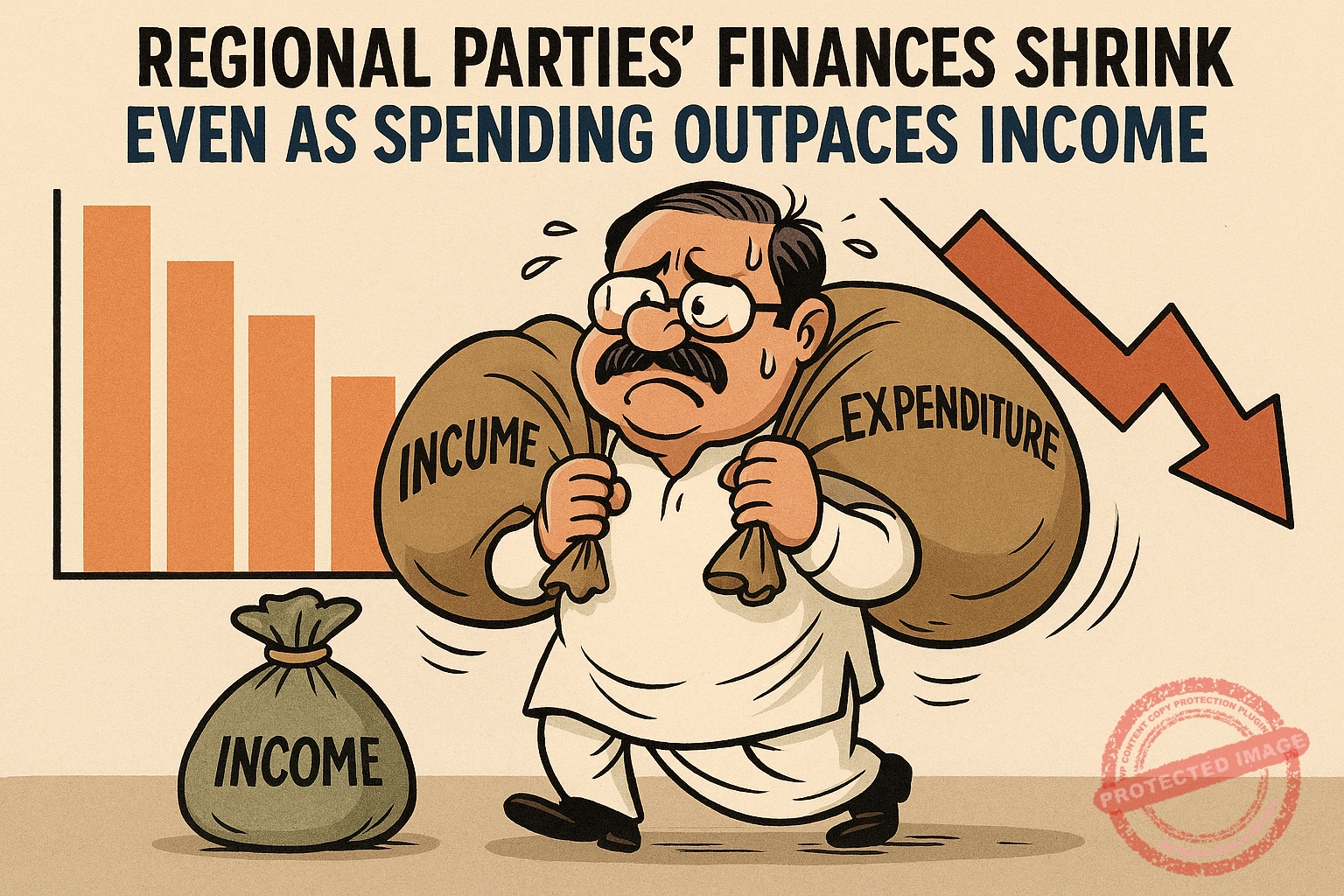
While the BJP generated the most income, it also spent aggressively. The party’s expenditure stood at Rs 3,774.58 crore, or 55.76 percent of its earnings. The Congress, on the other hand, spent Rs 1,111.94 crore—an amount that exceeded its income by more than Rs 193 crore. The CPI(M) reported an income of Rs 172.60 crore and expenses of Rs 173.86 crore, marginally higher than its revenue. The BSP declared Rs 58.58 crore in total income but spent Rs 106.30 crore—almost 81 percent more than what it earned. AAP reported a total income of Rs 39.28 crore and spent Rs 36.46 crore, while the NPEP declared Rs 2.18 crore in income and Rs 1.19 crore in expenditure.
The ADR report also tracked how party finances fluctuated compared to the previous year. The BJP recorded an impressive 55.95 percent jump in income—an increase of Rs 2,428.67 crore—between 2023–24 and 2024–25. The CPI(M) posted a modest 2.96 percent rise. The Congress, however, registered a 25 percent decline amounting to Rs 306.83 crore, while the BSP’s income dropped by nearly 10 percent. AAP saw one of the highest growth rates, with a 73 percent rise in earnings.
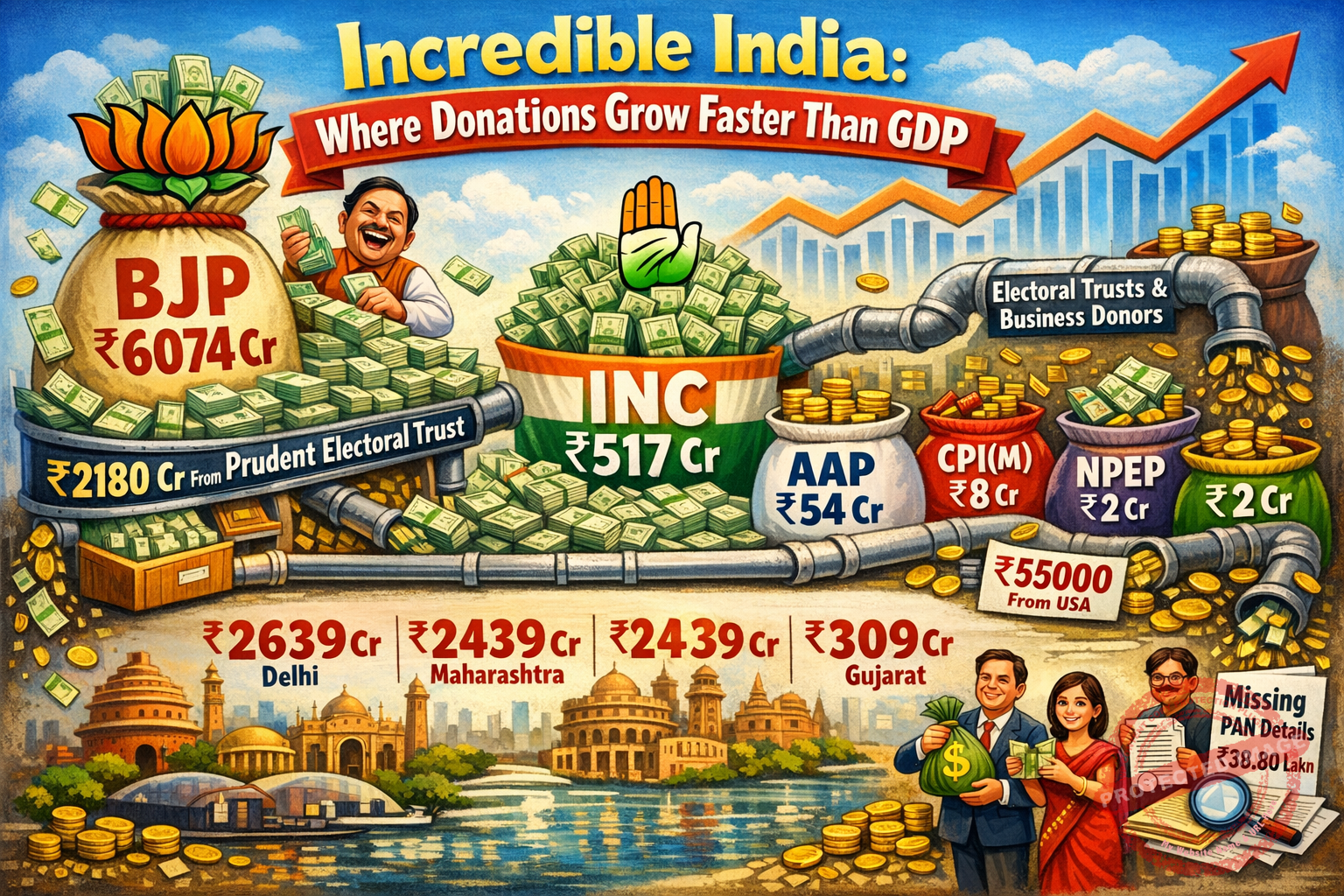
Where this money came from revealed an equally interesting picture. National parties together reported that 85 percent of their income—Rs 6,772.53 crore—was sourced from donations and contributions, while the remaining 15 percent came from other sources. The BJP declared that more than 90 percent of its income came from donations, amounting to Rs 6,124.85 crore. AAP reported an even higher dependence, with 99.85 percent of its earnings coming from contributions. NPEP followed closely at 97.74 percent. In dramatic contrast, the BSP reported that every rupee of its income came from “other sources,” with no donations at all. The Congress received 56.86 percent of its income from contributions and 43.14 percent from other sources, while the CPI(M) reported a near-even split between donations and miscellaneous income. For the Congress, the sale of coupons alone brought in Rs 350.12 crore—more than 38 percent of its total earnings.
The expenditure patterns offer a glimpse into how parties channel their financial muscle. The BJP spent Rs 3,335.36 crore on election and general propaganda, followed by Rs 323.05 crore on administrative costs. The Congress also devoted a major share of its spending—Rs 896.22 crore—to election-related expenses, with administrative and general costs accounting for another Rs 159.68 crore. The CPI(M) spent Rs 78.11 crore on administrative and general expenses, followed by Rs 51.03 crore on employee costs.
The ADR report paints a vivid picture of the massive financial disparities that shape India’s electoral landscape, where the BJP’s economic dominance far outstrips that of its rivals. The figures also point to a growing reliance on donations across parties, underscoring the central role that political funding continues to play in the country’s electoral machinery.