










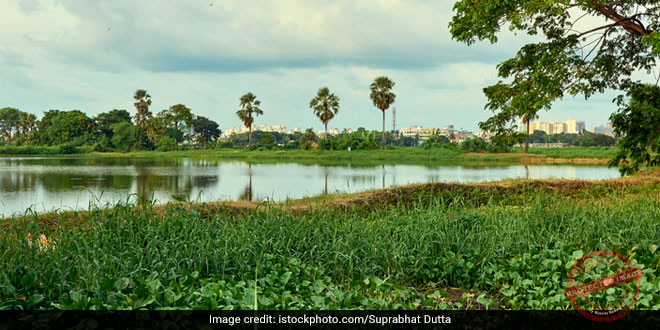
Ahead of World Wetlands Day on February 2, 2026, Union Minister for Environment, Forest and Climate Change Bhupender Yadav announced that two more sites have been added to India’s Ramsar network. The newly recognised wetlands—Patna Bird Sanctuary in Etah district of Uttar Pradesh and Chhari-Dhand in Gujarat’s Kutch district—have now been designated as Wetlands of International Importance.
Making the announcement on social media platform X, Yadav said the continued expansion of the Ramsar network under the leadership of Prime Minister Narendra Modi reflects India’s strong commitment to environmental protection and wetland conservation. India now has 98 Ramsar sites, a growth of over 276% from 26 sites in 2014.
The Minister noted that both newly added wetlands serve as crucial habitats for hundreds of migratory and resident bird species. They also support wildlife such as chinkara, wolves, caracal, desert cats and desert foxes, in addition to various endangered avian species.
India is a contracting party to the Ramsar Convention—an international treaty for the conservation and wise use of wetlands—signed in Ramsar, Iran, in 1971. The country became a signatory to the convention on February 1, 1982.
As of January 2026, India’s 98 Ramsar sites together cover 13,60,805.63 hectares. While only 26 such sites existed till 2014, 67 new wetlands have been added to the list in the past decade.
Under the Wetlands (Conservation and Management) Rules, 2017, the government’s definition of wetlands excludes river channels, paddy fields and areas used for commercial activities.
According to WWF‑India, wetlands continue to be among the most threatened ecosystems in the country. Factors such as vegetation loss, salinization, excessive flooding, pollution, invasive species, unregulated development and road construction have contributed to their rapid degradation.
Statewise, Tamil Nadu leads with 20 Ramsar sites, followed by Uttar Pradesh with 10. Bihar, Odisha and Punjab have six sites each; Jammu and Kashmir, Madhya Pradesh and Rajasthan have five each; Gujarat and Karnataka have four each; and Kerala, Himachal Pradesh and Maharashtra have three each. Haryana, Ladakh and West Bengal have two sites apiece, while Andhra Pradesh, Assam, Chhattisgarh, Goa, Jharkhand, Manipur, Sikkim, Mizoram, Uttarakhand and Tripura have one Ramsar site each.