










In a major advancement for sustainable energy storage, scientists have developed a new cathode material that significantly improves the performance and durability of aqueous zinc-ion batteries (AZIBs)—a technology increasingly seen as a promising alternative for large-scale grid storage.
A research team at the Center for Nano and Soft Matter Sciences (CeNS), Bengaluru—an autonomous institute under the Department of Science & Technology (DST)—has synthesized sulfur vacancy‑induced 1T-phase Molybdenum Disulfide (1T‑MoS₂), which could address one of the biggest bottlenecks in zinc‑ion battery technology: the lack of high-capacity, long‑lasting cathode materials.
Aqueous zinc-ion batteries, which use water-based electrolytes, are considered safer, cheaper, and more environmentally friendly than lithium-based systems. While zinc metal serves as a robust anode material, identifying an efficient cathode has remained a challenge.
The CeNS team—Ganesh Mahendra, Dr. Rahuldeb Roy and Dr. Ashutosh Kumar Singh—produced sulfur‑deficient 1T‑MoS₂ nanoflakes using a controlled hydrothermal technique. This metallic-phase material offers high conductivity and large surface area, enabling faster electrochemical reactions and enhanced charge storage.
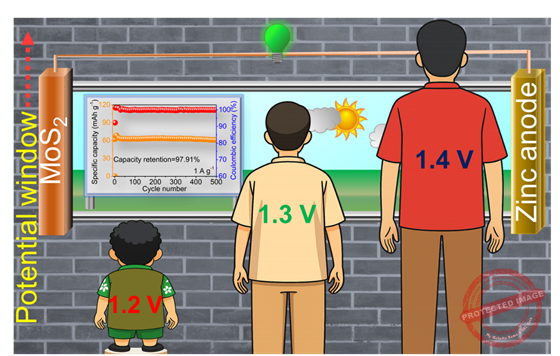
A key part of the research involved optimizing the electrochemical potential window, the voltage range within which the battery operates safely. The ideal window was identified as 0.2 to 1.3 volts (vs. Zn²⁺/Zn), a refinement that proved crucial in improving battery performance.
The resulting zinc‑ion battery exhibited exceptional stability, retaining 97.91% of its initial capacity even after 500 charge–discharge cycles at a current density of 1 A g⁻¹. It also demonstrated a Coulombic efficiency of 99.7%, indicating highly reversible zinc‑ion movement with minimal side reactions.
To showcase real‑world potential, the researchers powered a commercial LCD timer using a prototype coin-cell built with the new cathode material.
The findings, published in the journal Energy & Fuels of the American Chemical Society (ACS), provide a clear pathway for designing next‑generation cathode materials for zinc‑ion batteries.
Experts say the breakthrough could accelerate the development of affordable, safe and efficient energy storage systems, a crucial requirement for integrating large quantities of renewable power into the electricity grid.