










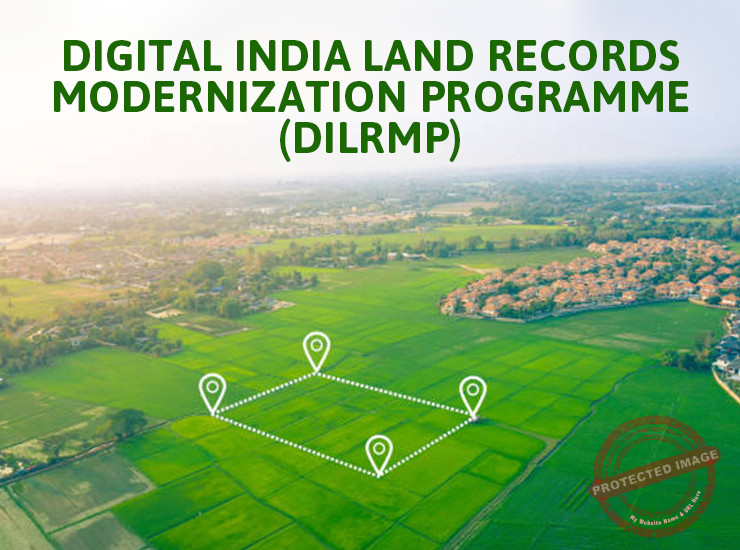
Landmark progress has been achieved under the flagship program of the Department of Land Resources —the Digital India Land Records Modernization Program (DILRMP) and the Watershed Development Component of PMKSY—with 2025 marking a year of near-total saturation in land record digitisation across the country.
Under DILRMP, land administration has transitioned from an “in-line” to an “online” system, with 97.27% of villages now fully computerised in terms of Records of Rights (RoRs). Cadastral maps have been digitised in 97.14% of the country, while 84.89% of villages have completed text-map integration, linking spatial data with ownership details.
Citizens in 19 states can now download digitally signed, legally valid land records from home, while banks in 406 districts can verify mortgages online, significantly speeding up loan approvals.
Simultaneously, the department has accelerated work on NAKSHA, a pilot program for modernising urban land management. In 157 Urban Local Bodies (ULBs), aerial surveys covering 5,915 sq km have been completed in 116 ULBs using high-resolution imagery. Ground truthing has begun in 72 ULBs, with 21 already completing the process. Under the SASCI 2025–26 scheme, Rs 1,050 crore has been recommended to 24 States and UTs that achieved designated NAKSHA milestones.
Two major initiatives were launched on December 31, 2025 which include the Land Stack, a GIS-based interoperable platform integrating land, ownership, registration, and building data for unified governance and the Glossary of Revenue Terms (GoRT), harmonising diverse revenue terminology across states by providing meanings of terms like Khasra, Dag, and Pula in vernacular languages, Hindi, English, and Roman script.
The department also reported significant expansion of the Unique Land Parcel Identification Number (ULPIN) system, or “Bhu-Aadhaar,” assigning each land parcel a unique 14-digit alphanumeric identity based on geospatial coordinates. As of November 2025, ULPIN has been issued for over 36 crore land parcels across 29 States and UTs, helping eliminate duplication and prevent benami transactions.
The National Generic Document Registration System (NGDRS) is now operational in 17 States and UTs, with 88.6% of Sub-Registrar Offices integrated with revenue offices, enabling automatic mutation of land records post-registration.
Key policy reforms in 2025 included the addition of a mandatory gender column in RoRs to generate gender-disaggregated land ownership data, supporting women-centric policies. The Revenue Court Case Management System (RCCMS) has been deployed in 22 States, enabling online filing, real-time case tracking, and instant record updates based on court orders.
To strengthen capacity-building, the department expanded its Centers of Excellence network to six, adding a new institute in Gujarat to train officials in drone surveys, GIS, modern land laws, and advanced digital mapping techniques.