










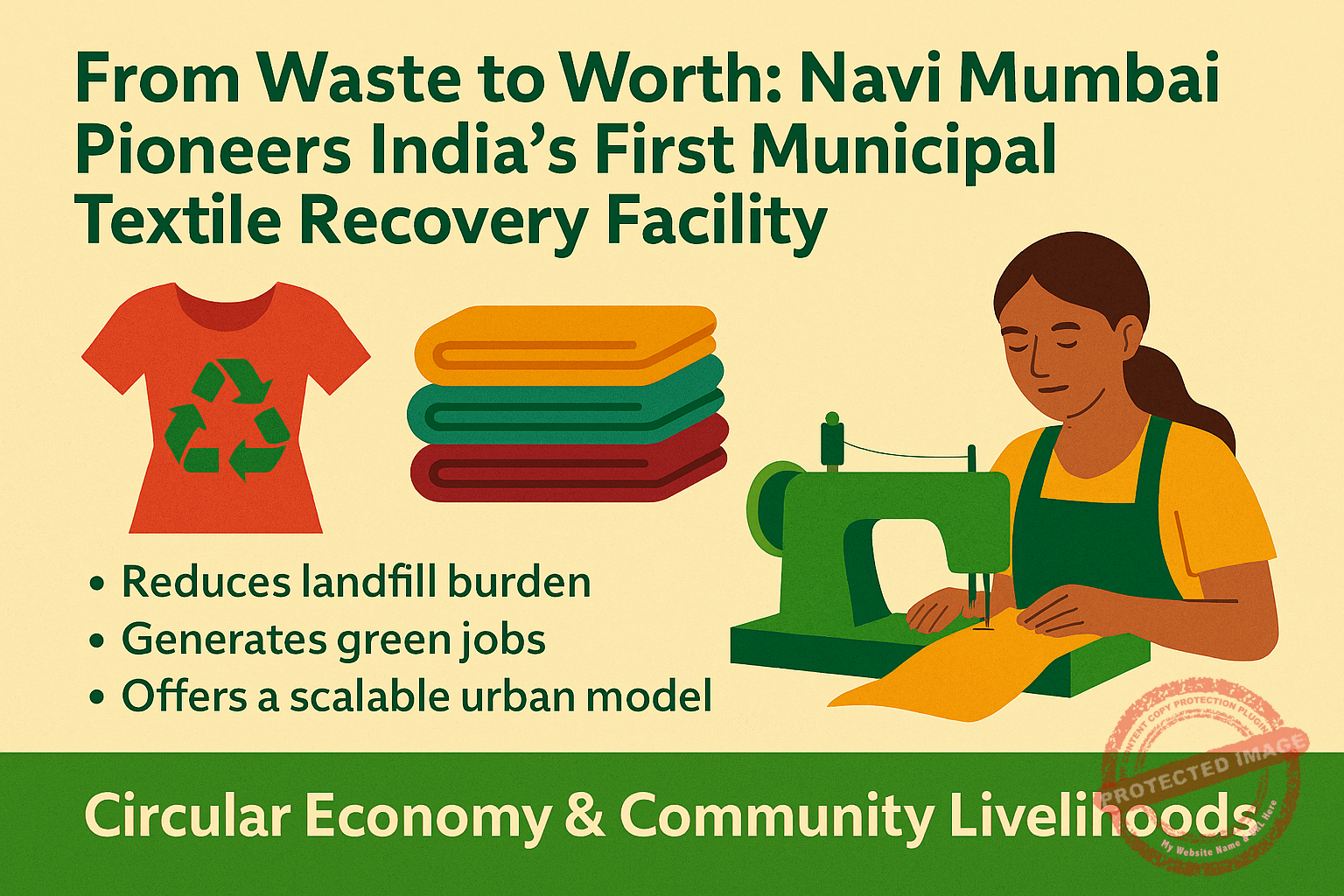
Navi Mumbai’s Textile Recovery Facility (TRF) is redefining how cities deal with textile waste by turning an overlooked waste stream into an engine of circular economy and community livelihoods. Established under Swachh Bharat Mission–Urban 2.0, the initiative reduces landfill burden, generates green jobs and offers a scalable model for urban India.
India produces nearly 7.8 million metric tonnes of post-consumer textile waste annually, ranging from clothing and uniforms to household linen. Much of this ends up in landfills due to the absence of organised recovery systems. Recognising this gap, the Navi Mumbai Municipal Corporation (NMMC) set up India’s first municipal Textile Recovery Facility in Belapur, positioning textile waste as a recoverable and valuable urban resource.
The TRF operates as a fully integrated circular ecosystem rather than a standalone drop-off centre. Decentralised collection forms its foundation, with branded textile bins placed across housing societies in all eight municipal wards. So far, 140 bins are operational, with plans to scale up to 250, ensuring easy access and broad citizen participation.
At the interim facility, housed in a repurposed urban health centre, collected textiles are weighed, tagged and scientifically sorted into reusable, recyclable, upcyclable, downcyclable and reject categories. Fibre-level identification is enabled through KOSHA handheld scanners, allowing real-time classification of cotton, polyester, polycotton, wool and silk. This scientific approach maximises material recovery and improves traceability.
A digital MIS platform is being developed to track textiles from donation to end use, strengthening transparency and data-led planning. After sorting, materials are sanitised and prepared for reuse or transformation. Suitable fabrics are upcycled into bags, mats, apparel, accessories and home décor items, crafted by women from local self-help groups.
The livelihoods component is central to the model. Over 300 women have been trained through structured eight-day Training-of-Trainers programmes covering fibre identification, segregation, repairing and upcycling. More than 150 women are now earning ₹9,000–15,000 per month through sorting, stitching and product-making, transforming homemakers into skilled practitioners of the circular economy.
In terms of impact, the TRF has collected 30 metric tonnes of textile waste, with 25.5 tonnes scientifically sorted. Over 41,000 items have been processed at an average of 500 items per day. Outreach efforts have reached more than 1.14 lakh families through 75+ IEC workshops, with over 350 housing societies onboarded. The facility has developed over 400 upcycled product samples and successfully piloted paper made from rejected textile waste, demonstrating innovation across the value chain.
To build awareness and markets, the TRF has participated in more than 30 exhibitions and public events, helping popularise textile reuse while providing women artisans visibility and income opportunities. Early challenges—such as resistance to bin placement, low awareness and complex mixed-fibre sorting—were addressed through phased implementation, sustained community engagement and technology adoption.
Encouraged by the success of the Belapur facility, NMMC plans a permanent, higher-capacity TRF at Koparkhairane near Nisarg Udyan. The Navi Mumbai model shows how textile waste can be transformed from a residual burden into a source of environmental value, inclusive livelihoods and urban sustainability, strongly aligned with Swachh Bharat 2.0, the Smart Cities Mission and SDG 12 on responsible consumption and production.