










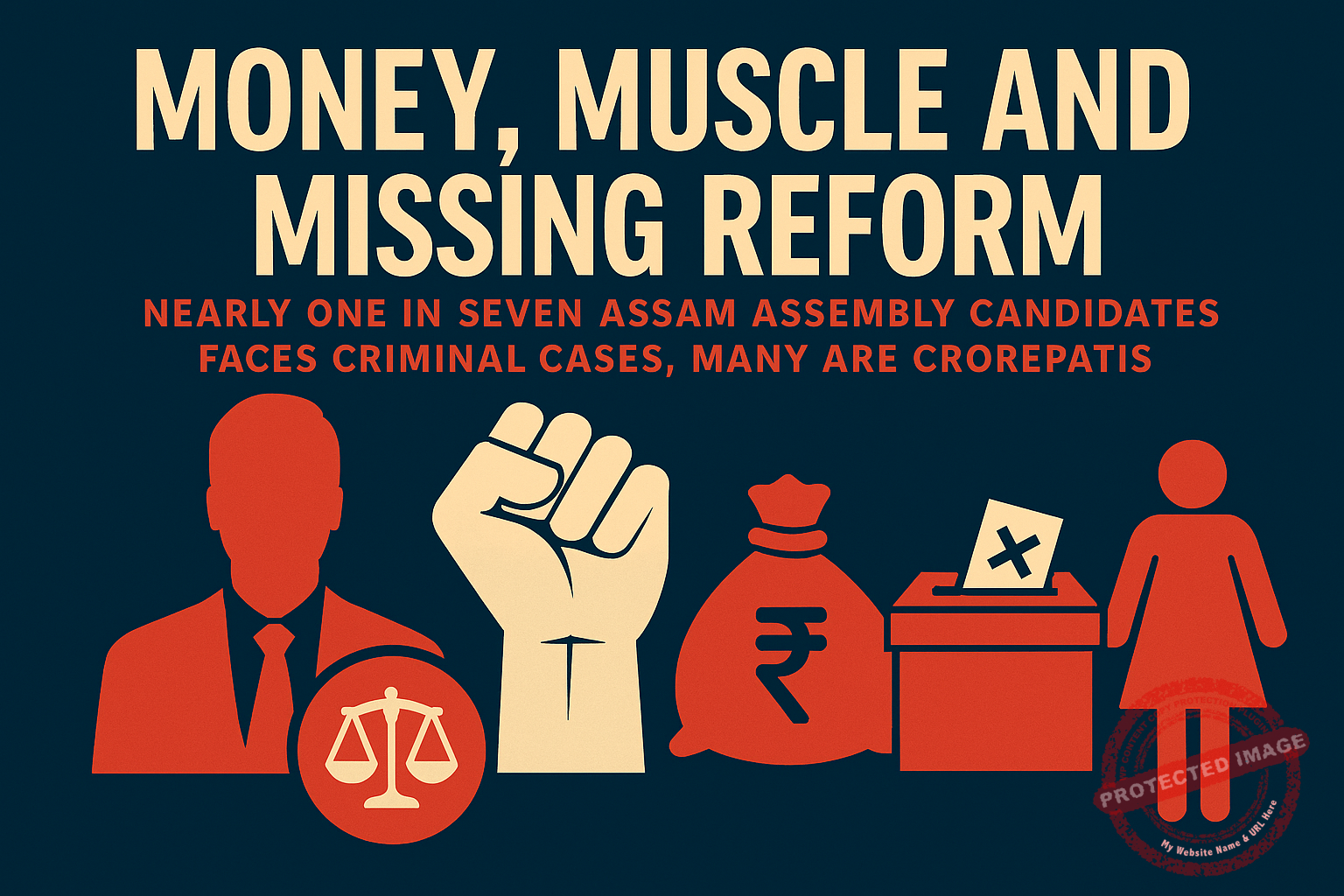
Nearly one in seven candidates contesting the 2026 Assam Assembly elections has a criminal case against their name, and many of them are wealthy, repeat contenders—underscoring once again how money and muscle power continue to dominate the state’s electoral battlefield.
An analysis of self‑sworn affidavits by the Association for Democratic Reforms (ADR) and Assam Election Watch shows how out of 722 candidates in the fray, 102 candidates—or 14 per cent—have declared criminal cases. Even more alarming, 82 candidates, accounting for 11 per cent, face serious criminal charges, including murder and attempted murder. These figures show only a marginal dip from the 2021 elections, making it clear that little has changed despite repeated court warnings.
Political parties across the spectrum continue to field candidates with tainted backgrounds. The Congress tops the list among major parties, with 28 per cent of its candidates declaring criminal cases, followed closely by AIUDF at 37 per cent and Asom Gana Parishad at 23 per cent. Even the BJP, which has the lowest proportion among big parties, has still fielded candidates with criminal records. None of the major parties can claim a clean slate.
Serious criminal allegations are widespread. Eight candidates have admitted to murder cases, while nine face charges of attempted murder. Two candidates have cases related to crimes against women.
Despite Supreme Court directions issued in February 2020, parties have failed to offer credible reasons for selecting such candidates. Past elections show that excuses like “popularity” or “political vendetta” are routinely offered, hollowing out the very purpose of judicial reform.
Equally striking is the growing influence of money in Assam politics. As many as 285 candidates—39 per cent of the total—are crorepatis, a sharp rise from 28 per cent in the 2021 assembly elections. Every major party has overwhelmingly preferred wealthy candidates. Almost nine out of ten BJP candidates and more than half of Congress and AIUDF nominees have assets exceeding Rs 1 crore.
The total declared assets of all candidates put together stand at a staggering Rs 2,352 crore. On average, each candidate is worth Rs 3.25 crore, up dramatically from Rs 2.10 crore five years ago. Candidates from AIUDF and Bodoland People’s Front report the highest average assets, close to Rs 10 crore each, while BJP and Congress candidates also hover around the Rs 7‑crore mark.
The wealth gap becomes even more glaring when looking at sitting legislators. Eighty‑three MLAs are re‑contesting the elections, and their average assets have jumped from Rs 4.17 crore in 2021 to Rs 7.52 crore in 2026—an 80 per cent increase in just five years. This explosive growth raises uncomfortable questions about the cost of politics and the rewards of power.
Beyond money and crime, representation remains skewed. Women account for only 8 per cent of candidates, unchanged from the previous election. Nearly half the contestants have declared liabilities, and while a slim majority are graduates, a significant number have only school‑level education. Most candidates fall in the middle‑aged bracket of 41 to 60 years, leaving youth and women largely on the margins.
Taken together, the data paints a sobering picture. Despite court orders, public debate and repeated promises of reform, electoral politics in Assam remains captive to wealth, winnability and questionable backgrounds. As voters prepare to head to the polls, the gap between democratic ideals and electoral reality remains as wide—and as troubling—as ever.