










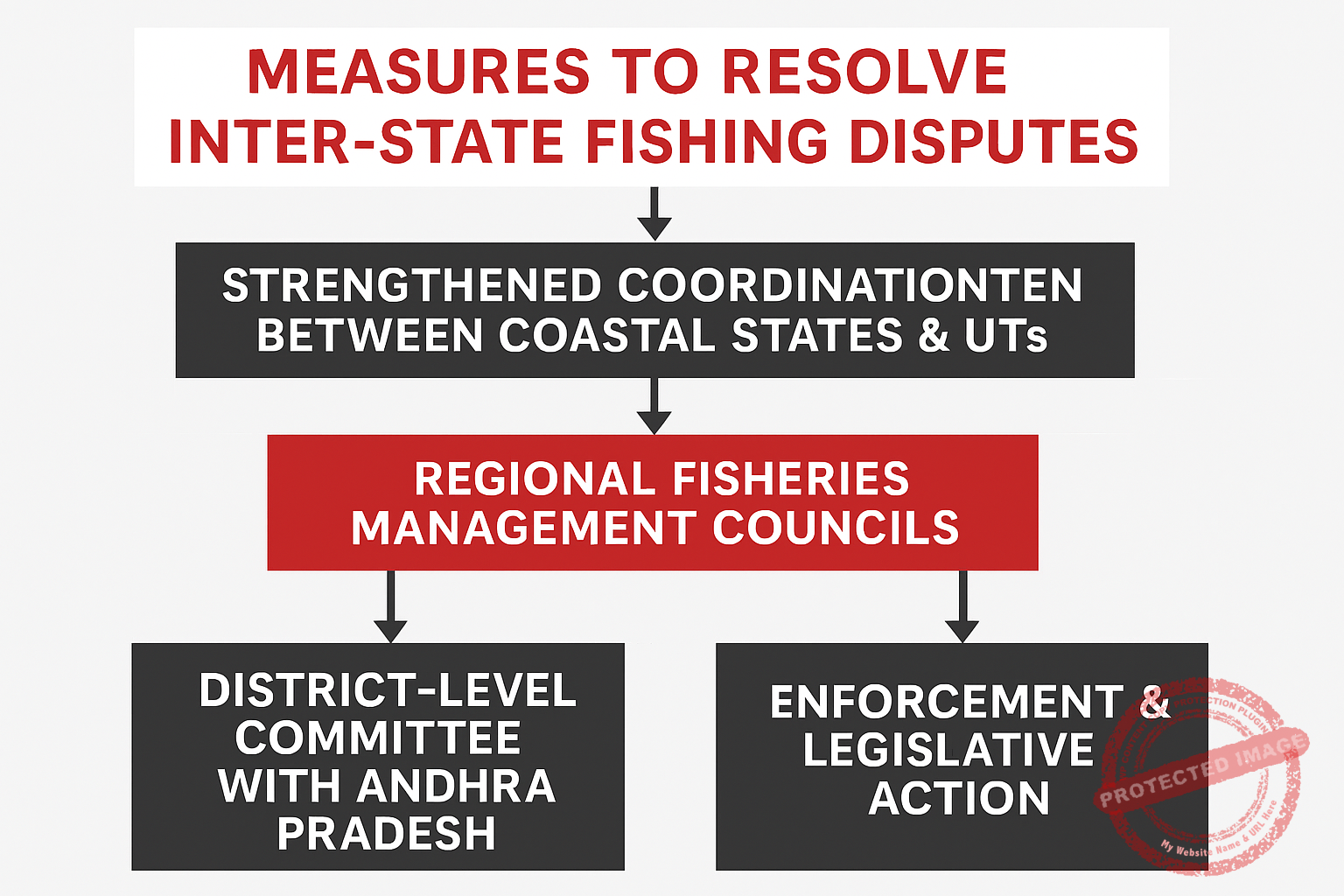
Seeking to calm longstanding tensions along India’s eastern seaboard, the Union Government has expanded coordination mechanisms between coastal States and Union Territories to prevent recurring inter‑state fishing disputes and protect the livelihoods of traditional marine communities. With States managing fishing within 12 nautical miles and the Centre regulating the Exclusive Economic Zone beyond that, cooperation across jurisdictions has become crucial as overlapping fishing activities increasingly spark friction.
Coastal States and UTs enforce their respective Marine Fishing Regulation Acts (MFRAs) and many have demarcated exclusive zones for traditional, non‑mechanized and motorized craft. Despite these safeguards, Andhra Pradesh continues to report instances of mechanized vessels from Tamil Nadu and Puducherry crossing into its territorial waters, including in the ecologically sensitive Pulicat Lake region and designated traditional fishing zones.
Responding to these concerns and acting on recommendations of the Inter‑State Council, the Department of Fisheries constituted three Regional Fisheries Management Councils (RFMCs) on 29 March 2023, covering the western, eastern and southern coasts. These Councils now serve as institutional platforms for States and UTs to jointly address disputes, streamline enforcement and ensure equitable access to marine resources. The Indian Coast Guard participates in all RFMCs, strengthening real‑time coordination on maritime operations.
Tamil Nadu has conveyed that it continues coordinated action with neighbouring administrations to prevent cross‑border fishing violations and safeguard its fishermen. Following issues raised by Andhra Pradesh in the Southern RFMC meeting on 19 August 2023, the Tamil Nadu Government issued an Order on 31 January 2024 forming a District‑Level Committee comprising Collectors and officials from Thiruvallur, Chennai and Chengalpattu districts, along with their counterparts from SPSR Nellore, Prakasam and Tirupati in Andhra Pradesh. The Committee has been tasked with sensitising fishermen about regulatory boundaries, preventing on‑sea conflicts and addressing operational grievances between the two States. Tamil Nadu has also confirmed that action is being taken against offending vessels under its Marine Fishing Regulation Act, 1983, based on photographic and video evidence provided by Andhra Pradesh authorities.
Meanwhile, Andhra Pradesh continues to flag illegal fishing incidents involving vessels from Puducherry and is pursuing amendments to its Marine Fishing Regulation Act, 1994, to incorporate stronger provisions to curb illegal, unreported and unregulated (IUU) fishing.
With enhanced cooperation, evidence‑based enforcement and dedicated joint committees now in place, the Centre and coastal administrations expect a significant reduction in inter‑state fishing disputes and improved long‑term sustainability of marine resources along India’s coastline.