










Political dynasties are not unique to India—most democracies and non-democracies across the world grapple with them—but their imprint on India’s political landscape remains unusually deep. The legacy of family rule, which has persisted since Independence, continues to influence policymaking, leadership choices, and even voter behaviour.
In India, dynastic politics often emerges from factors such as party structures, historical leadership patterns, limited inner-party democracy, and voters’ inclination toward familiar names. And every election season, the issue resurfaces as a potent campaign tool, with rivals targeting candidates who come from well‑known political families. The charge of ‘pariwarwaad’ may not always change outcomes, but it has undeniably shaped political discourse.
While political families argue that dynastic continuity ensures experience and organisational stability, critics warn that it undermines meritocracy, weakens accountability, and restricts broader representation. In India, a leader is classified as dynastic if they have identifiable family ties to former or serving MPs, MLAs, MLCs, or influential party leaders.
The phenomenon goes beyond electoral positions. In many cases, politicians place relatives in decision-making roles in government bodies, corporations, and public sector undertakings—areas not fully captured in formal reports. Many dynasts remain politically active even after losing elections, ensuring their influence persists.
A recent nationwide analysis by the Association for Democratic Reforms (ADR) and National Election Watch (NEW) underlines the extent of dynastic penetration in India’s legislatures. Examining 5,203 sitting MPs, MLAs and MLCs across the country, the study found that 1,106 legislators—about 21%—come from political families. That means one in every five elected representatives in India has dynastic roots.
The grip of political families is strongest in the Lok Sabha, where 31% of MPs hail from established political lineages. In contrast, State Assemblies show a relatively lower—though still significant—figure of 20% dynasts among sitting MLAs. The Rajya Sabha stands at 21%, while Legislative Councils record 22% dynastic representation.
A closer look at the numbers reveals:
-
Lok Sabha: 166 of 542 MPs (31%) are dynasts.
-
State Assemblies: 816 of 4,091 MLAs (20%) have political lineage.
-
Rajya Sabha: 47 of 224 MPs (21%) come from political families.
-
State Legislative Councils: 77 of 346 MLCs (22%) have dynastic backgrounds.
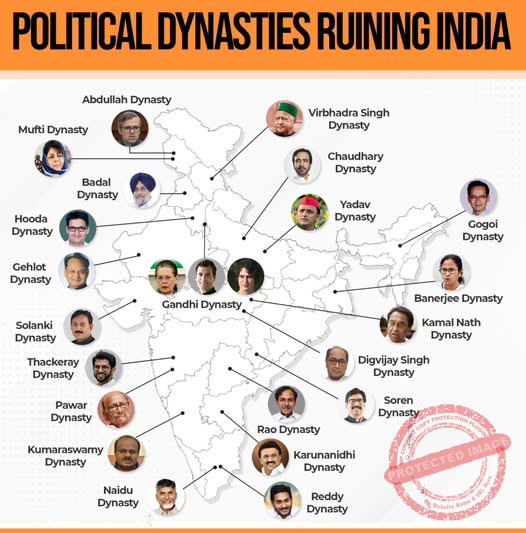
India’s most recognisable political dynasty remains the Nehru–Gandhi family, frequently cited as the face of dynastic politics. But the phenomenon extends far beyond the Congress. The Mulayam Singh Yadav–led Samajwadi Party in Uttar Pradesh, Ram Vilas Paswan’s Lok Janshakti Party (LJP) and Lalu Prasad Yadav’s Rashtriya Janata Dal (RJD) in Bihar, the Karunanidhi family in Tamil Nadu, and political families like the Pilots, Rajes and Scindias in Rajasthan all illustrate its widespread presence. Former Prime Minister H.D. Deve Gowda’s family in Karnataka and the Patnaiks in Odisha are further examples of entrenched family rule.
Supporters argue that these families provide organisational cohesion and continuity. But detractors remain wary of what they call a systemic “inheritance of power,” warning that it sidelines grassroots leaders and restricts entry for fresh talent.
Regardless of the debate, the data makes one thing clear: dynastic politics is not merely a feature of Indian democracy—it is one of its defining pillars. And with one‑fifth of all legislators belonging to political families, the trend shows no immediate signs of fading.