










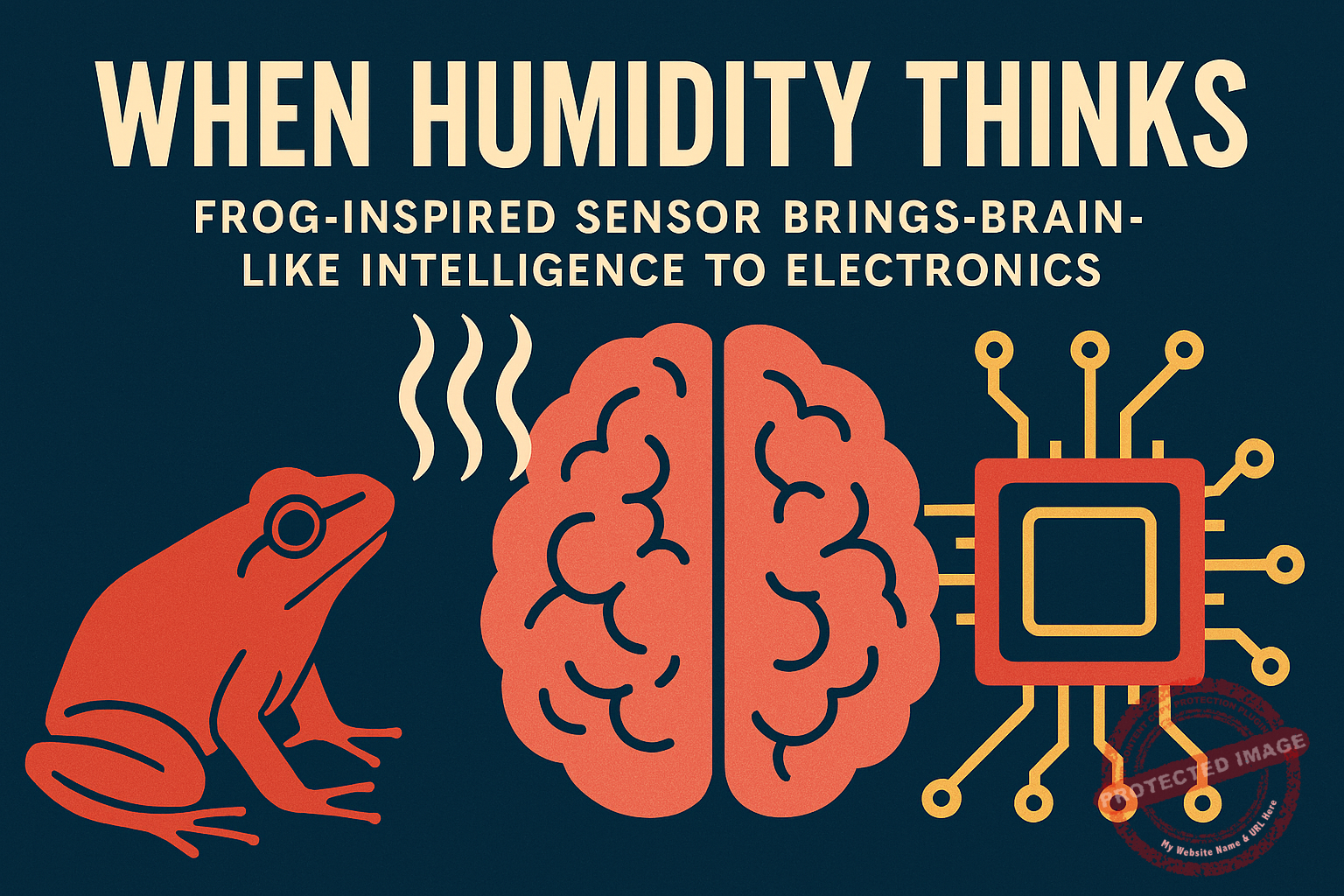
A tiny sensor that “thinks” more like a living brain—and responds to changes in humidity the way an animal does—has been developed by Indian researchers, opening new possibilities for ultra‑efficient smart electronics.
Scientists at the Jawaharlal Nehru Centre for Advanced Scientific Research (JNCASR), Bengaluru, have created a neuromorphic humidity sensor that can sense, process and store information within a single device. Unlike conventional electronics, which rely on separate sensors, memory units and processors, this device mimics how biological systems work, dramatically cutting energy use and data‑processing needs.
Neuromorphic electronics are gaining attention as today’s computing systems struggle to keep up with the soaring energy demands of artificial intelligence, edge computing and the Internet of Things. In nature, sensory organs such as the brain and nervous system perform multiple tasks at once—detecting signals, processing them and remembering past experiences.
Replicating this efficiency in electronics has been a long‑standing challenge.
Most neuromorphic sensors still depend on separate sensing elements and memristive devices for computing, leading to higher energy consumption. The JNCASR team has taken a different approach. Their sensor uses one‑dimensional supramolecular organic nanofibres that respond directly to moisture, allowing synapse‑like behaviour to emerge within the same material.
The inspiration came from an unlikely source: amphibians, particularly cricket frogs. These frogs show strong changes in neural activity depending on moisture levels and daylight. Similarly, the newly developed device shows changes in electrical current when humidity fluctuates and can temporarily “remember” earlier humidity signals—much like short‑term memory in the brain. Light was also found to influence its response.
To build the device, researchers Tejaswini S. Rao and Sukanya Baruah grew nanofibres from a charge‑transfer complex of donor and acceptor molecules. These fibres were deposited on gold electrodes and tested in a controlled humidity environment. Pulses of humidity produced key synaptic functions such as signal facilitation, depression and metaplasticity, demonstrating that the device can carry out basic information‑processing tasks.
“This is the first time humidity has been used as the primary stimulus to emulate synaptic behaviour in a neuromorphic device,” the researchers noted. Their findings have been published in the Journal of Materials Chemistry C.
The technology could pave the way for smart environmental sensors that adapt in real time to changing conditions. Potential applications range from wearable health monitors and medical devices to low‑power AI systems and sustainable edge‑computing platforms. By bringing electronics closer to the efficiency of biological systems, the work marks an important step toward the future of energy‑efficient, intelligent technologies.