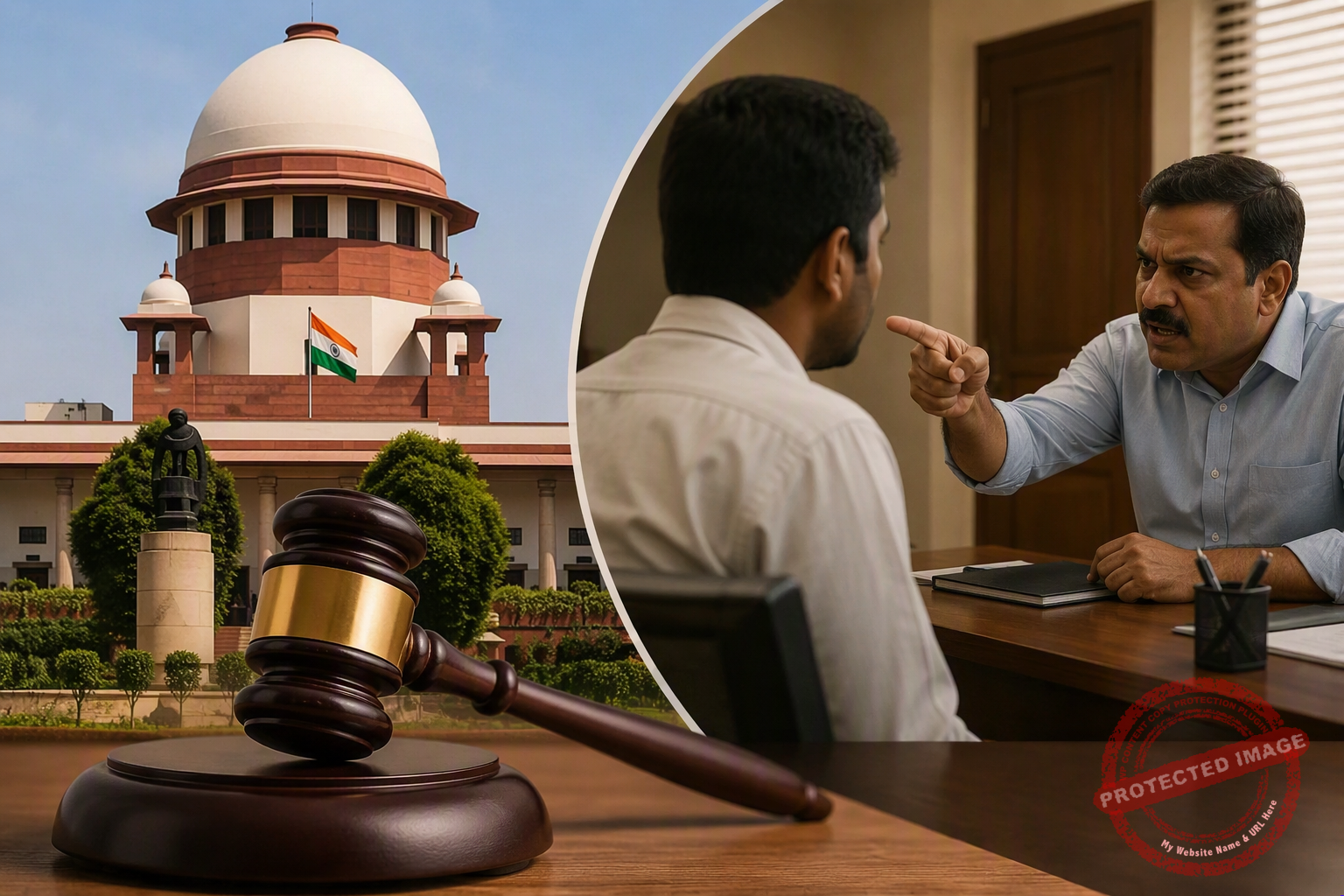
In a significant ruling on the interpretation of the Scheduled Castes and Scheduled Tribes (Prevention of Atrocities) Act, 1989, the Supreme Court has held that an alleged casteist remark made within the confines of a closed room cannot automatically be treated as an offence committed in “public view.”
On this basis, the apex court quashed proceedings initiated against a school manager under Sections 3(1)(r) and 3(1)(s) of the SC/ST Act. However, it clarified that criminal proceedings relating to other offences registered under the Indian Penal Code (IPC) would continue.
A bench comprising Justice Vikram Nath and Justice Sandeep Mehta passed the order while allowing an appeal against a judgment of the Allahabad High Court.
Case Background
The case arose from an incident at a school in Uttar Pradesh. According to the complainant, he had visited the school manager to discuss a dispute involving students. During the meeting, the manager and certain staff members allegedly assaulted him and used caste-based slurs. Based on the complaint, police registered an FIR and later filed a chargesheet under the SC/ST Act.
The school manager, however, denied the allegations. His wife also filed a cross-FIR, claiming that the complainant had forcibly entered the school office and engaged in misconduct and assault. The local court subsequently took cognisance of the chargesheet filed in the cross-case as well.
Supreme Court’s Observations
Examining the requirements of Sections 3(1)(r) and 3(1)(s) of the SC/ST Act, the Supreme Court said that the central issue was whether the alleged casteist remarks had been made in a place falling within the ambit of “public view.”
The Court noted that the incident was alleged to have taken place inside a closed room and that the prosecution had failed to establish, even on a prima facie basis, that the remarks were made in a setting where members of the public could witness or hear them.
The bench observed that an incident occurring behind closed doors, in the absence of ordinary members of the public, cannot by itself satisfy the statutory requirement of being within “public view.”
High Court Proceedings
The school manager had challenged the special court’s summons order before the Allahabad High Court. However, the High Court declined to interfere, holding that the allegations appeared prima facie genuine and that the proceedings could not be quashed merely on the ground of alleged vendetta.
The matter was thereafter taken to the Supreme Court, which set aside the proceedings under the SC/ST Act while allowing the prosecution under other applicable criminal provisions to continue.