










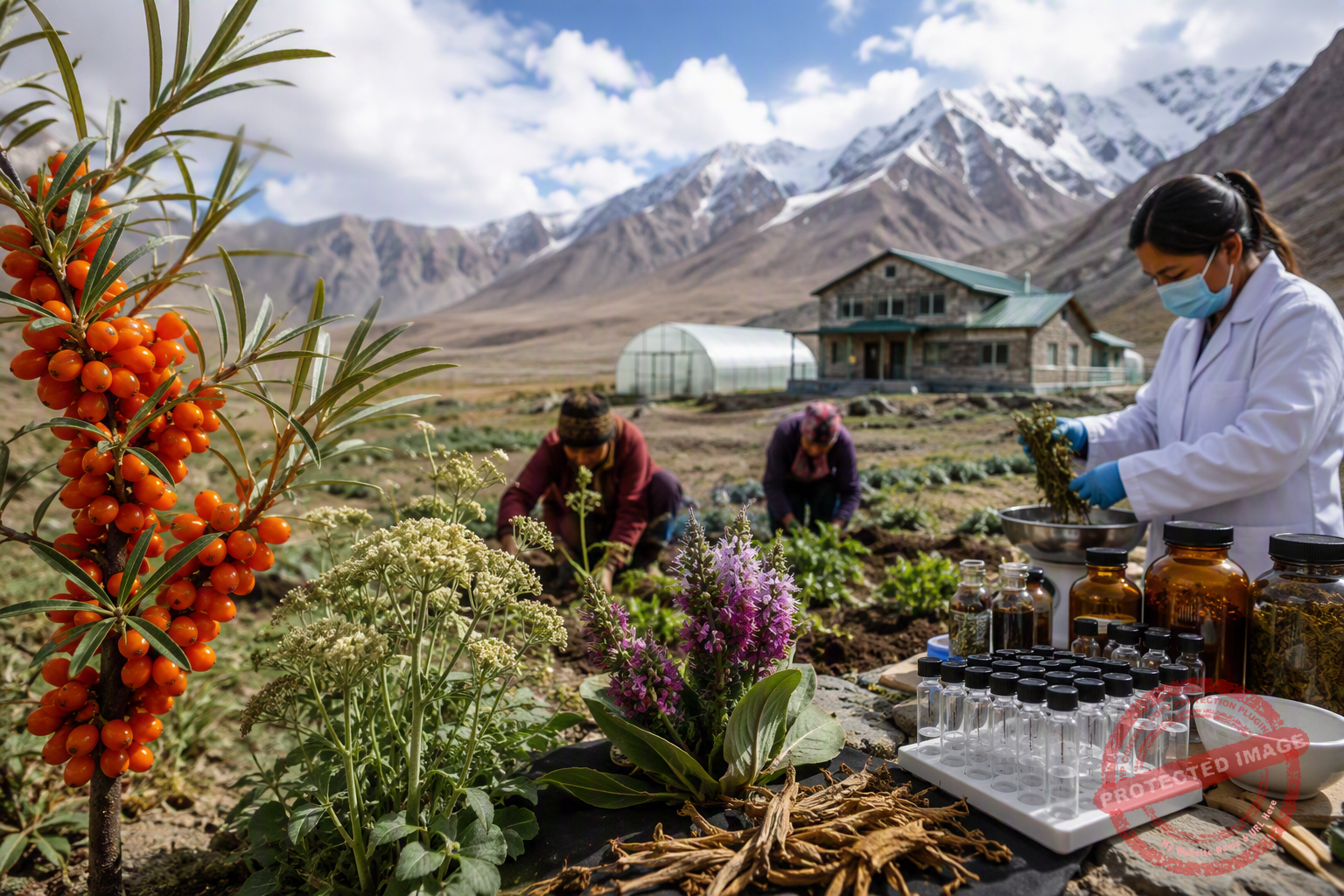
Ladakh’s unique high-altitude landscape is emerging as a promising hub for medicinal plant cultivation, with the Centre stepping up efforts to promote species such as seabuckthorn, rhodiola, artemisia and aconitum. Recognising the region’s rich biodiversity and favourable agro-climatic conditions, the Ministry of Ayush and its agencies are supporting conservation, cultivation, processing and marketing initiatives aimed at creating sustainable livelihoods for local communities.
The National Medicinal Plants Board (NMPB) is implementing its Central Sector Scheme on the conservation, development and sustainable management of medicinal plants across the country, including Ladakh. Under the scheme, assistance is provided for producing quality planting material, conducting awareness campaigns among farmers, establishing post-harvest and marketing infrastructure, and ensuring testing and certification of medicinal plant produce.
To improve market access, the NMPB has launched the e-CHARAK mobile application and web portal, which provide medicinal plant growers with information in multiple local languages. The platform offers regular updates on market prices from herbal markets across India, including Ladakh, and helps farmers connect with buyers. The board also shares procurement requirements of major herbal companies with state agencies to strengthen market linkages for cultivators and collectors.
At the local level, the State Medicinal Plants Board (SMPB) of Ladakh has been actively encouraging scientific cultivation and conservation of medicinal plants through training programmes, seminars, workshops and buyer-seller meets. Working with research institutions and government departments, the board is focusing on awareness generation, value addition and sustainable utilisation of the region’s medicinal plant resources.
The Ministry of Ayush is also supporting Ladakh through the National AYUSH Mission (NAM), which funds a range of healthcare and infrastructure projects. These include Ayushman Arogya Mandirs, co-location of AYUSH services in government health facilities, upgradation of hospitals and dispensaries, establishment of integrated AYUSH hospitals, supply of essential medicines and public health programmes. During the last five years, the ministry released Rs 705.11 lakh to Ladakh for approved AYUSH projects, of which Rs 534.24 lakh has been utilised.
Officials said efforts are also underway to overcome challenges faced by the medicinal plant sector through capacity-building programmes and infrastructure development. Support has been extended for setting up post-harvest processing and quality-testing facilities, helping create local employment opportunities while improving the quality and marketability of medicinal plant products.
The NMPB’s ongoing scheme additionally supports research and development, marketing promotion, livelihood generation through self-help groups and biodiversity management committees, and strengthening supply chains from cultivation to sale.
A major boost to the sector has come from the establishment of a Centre of Excellence for Seabuckthorn at Nimoo in Leh. Set up under the Mission for Integrated Development of Horticulture (MIDH) with financial assistance of Rs 789.33 lakh, the project was launched in 2020-21 by the Department of Horticulture, UT Ladakh, with technical support from the Defence Institute of High-Altitude Research (DIHAR).
The centre houses a scientific orchard, model nursery, training and demonstration facilities, and a primary processing unit. It serves as a hub for developing quality planting material, demonstrating cultivation and processing technologies, establishing model orchards and nurseries, and training farmers, women entrepreneurs, self-help groups and farmer producer organisations.
Officials believe the initiative will strengthen the entire seabuckthorn value chain in Ladakh by promoting scientific farming practices, improving processing capabilities and creating new income opportunities for local communities. With sustained government support and growing market demand, the region’s high-altitude medicinal plants are increasingly being seen as a valuable resource for economic development as well as traditional healthcare.