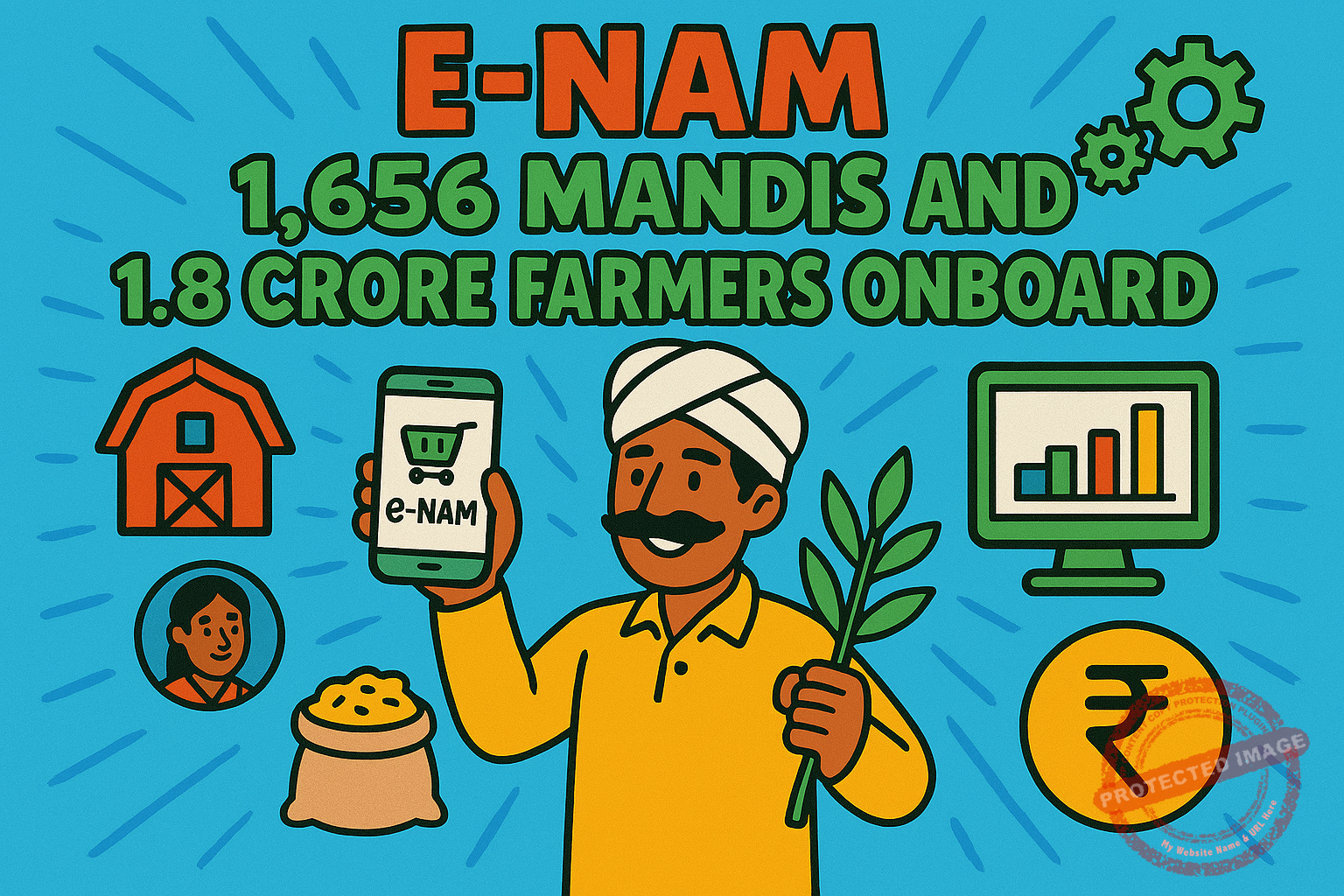
The Government has been implementing the National Agriculture Market, or e‑NAM, since 2016 as an online platform that connects wholesale mandis across States and Union Territories to enable transparent and competitive trading of agricultural commodities. Over the years, the platform has expanded steadily, and so far, 1,656 mandis from 23 States and 4 UTs have been integrated into the system.
As of February 28, 2026, e‑NAM has registered 1.80 crore farmers and 2.72 lakh traders, along with 4,724 Farmer Producer Organizations. Since its launch, the platform has seen the trading of 13.22 crore metric tonnes of agricultural produce valued at Rs 4,82,350 crore. By allowing farmers to access a wider network of buyers through online bidding, e‑NAM helps them secure better price discovery and improved price realization, with payments transferred directly to their bank accounts.
In Rajasthan, 134 e‑NAM mandis are now using AI- and machine‑learning‑based equipment for quality assaying of agricultural commodities, significantly reducing testing time. The Government of India has provided assistance for these facilities under the e‑NAM scheme. To support States in integrating mandis with the platform, the government offers up to Rs 75 lakh per mandi for infrastructure such as quality testing labs, electronic weighing systems, computers, printers, grading and packaging units, software support, and compost facilities.
Across India, the number of mandis linked to e‑NAM varies by region. These include Andaman and Nicobar Islands with 1 mandi, Andhra Pradesh with 33, Assam with 3, Bihar with 20, Chandigarh with 1, Chhattisgarh with 21, Goa with 7, Gujarat with 144, Haryana with 114, Himachal Pradesh with 38, Jammu and Kashmir with 17, Jharkhand with 19, Karnataka with 5, Kerala with 6, Madhya Pradesh with 139, Maharashtra with 181, Nagaland with 19, Odisha with 66, Puducherry with 4, Punjab with 156, Rajasthan with 173, Tamil Nadu with 213, Telangana with 57, Tripura with 19, Uttar Pradesh with 162, Uttarakhand with 20 and West Bengal with 18 mandis.